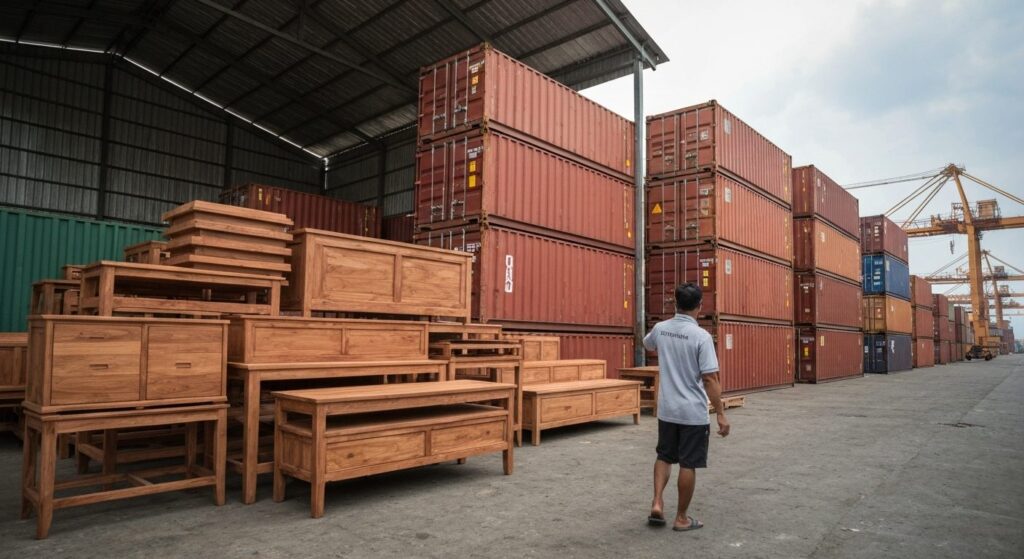
Understanding Indonesia sourcing facts is fundamental for any international buyer engaging with the Indonesian export market. This page provides a precise, fact-based overview of key processes, regulations, and logistical considerations for sourcing goods, particularly furniture, rattan, and home decor, from Indonesia. Bali Export Broker, operating under Juara Holding Group, serves as an accountable buying agent, managing supplier matching, quality control, container consolidation, export documentation, and freight for our clients.
What is an Export Broker and Buying Agent?
An export broker acts as an intermediary facilitating the sale of goods from a producer in one country to a buyer in another. For Indonesia, an export broker streamlines the complex process of international trade, often specializing in specific product categories. A buying agent, conversely, represents the buyer’s interests directly, working to source products, negotiate terms, manage quality, and oversee logistics on behalf of their client.
Bali Export Broker functions as a comprehensive buying agent and export broker. For furniture, rattan/natural-fiber, and recycled teak and home decor, we source directly from our vetted network of Bali and Jepara workshops, where we have established direct oversight. For all other product categories, we commission-match clients with vetted producer partners. This distinction is critical for transparency: we operate with direct control over quality and production for our core categories, while for others, we leverage trusted partnerships. We never claim factory ownership, certifications, awards, or commission percentages that cannot be independently verified.
Our value as your buying agent is rooted in accountability and expertise, not in claiming an unpaid status. We operate on a transparent commission/service fee structure, which is clearly communicated upfront. This allows us to dedicate our resources to ensuring quality control, compliance, and smooth export processes, acting as your dedicated representative on the ground.
The Value Proposition of a Dedicated Buying Agent
Engaging a dedicated buying agent in Indonesia offers a buyer several layers of defense against common export challenges. From our perspective as the Quality Control & Compliance desk, this means:
- Quality Assurance: Implementing in-line production checks against approved samples and conducting AQL (Acceptable Quality Limit) pre-shipment inspections. This prevents wrong quality issues before they escalate.
- Compliance Verification: Ensuring all products meet specified standards, including critical checks like moisture content verification for solid wood to prevent splitting in transit or upon arrival.
- Documentation Accuracy: Meticulously handling export documentation and timber legality paperwork, including correct HS codes, Certificates of Origin (COO), Pemberitahuan Ekspor Barang (PEB), and SVLK/V-Legal routing through certified workshops. This is crucial for preventing containers from being held at port.
- Risk Mitigation: Proactively addressing potential issues from production floor to port, safeguarding your investment and supply chain integrity.
The Role of Quality Control and Compliance
Quality control (QC) and compliance are the backbone of reliable sourcing from Indonesia. As your representative, my team implements a multi-stage inspection process to ensure products meet your exact specifications and international standards.
In-Line Production Checks
During the manufacturing process, our team conducts regular in-line checks. This involves comparing ongoing production against the buyer’s approved sample. Deviations are identified and rectified early, minimizing waste and delays. This proactive approach is critical for categories like furniture, where complex assembly and finishing stages occur.
AQL Pre-Shipment Inspection
Before shipment, a comprehensive AQL (Acceptable Quality Limit) inspection is performed. This statistical sampling method determines whether a batch of goods meets the quality standards specified by the buyer. For critical defects, Bali Export Broker maintains a zero-tolerance policy, meaning any critical defect found during AQL results in a failure of the entire batch, requiring immediate rectification or rejection. Minor and major defects are assessed against agreed AQL levels.
Moisture Content Verification for Solid Wood
One of the most frequent causes of post-delivery issues with wooden furniture is incorrect moisture content. For solid wood products, we rigorously verify the moisture content (MC) using specialized meters. The target moisture content for most export-grade solid wood furniture from Indonesia is typically 6-8%. Wood exceeding this range is highly susceptible to splitting, warping, and cracking once exposed to drier climates, leading to significant financial losses and customer dissatisfaction. Our verification process ensures stability and longevity of the product.
Understanding Indonesian Timber Legality: SVLK and V-Legal
Indonesia has made significant strides in combating illegal logging through its robust timber legality assurance system, known as SVLK (Sistem Verifikasi Legalitas Kayu). This system is crucial for the export of all timber and timber products from Indonesia.
SVLK: Indonesia’s Timber Legality Assurance System
SVLK is a mandatory national system designed to ensure that all timber products originating from Indonesia are legally sourced, processed, and traded. It covers the entire supply chain, from forest concessions to processing mills and exporters. Indonesia was the first Asian country to sign a Voluntary Partnership Agreement (VPA) with the European Union in 2013, which led to the full implementation of the Forest Law Enforcement, Governance and Trade (FLEGT) licensing scheme in November 2016.
V-Legal: The FLEGT License
The V-Legal document acts as Indonesia’s FLEGT License. For timber and timber products exported to the EU and other VPA signatory countries, a V-Legal document confirms compliance with SVLK, simplifying customs procedures and ensuring market access. Each V-Legal certificate is valid for a period of 4 months from its issuance date. Exporters must route their products through SVLK-certified workshops to obtain this crucial documentation. Bali Export Broker ensures all timber and timber products handled directly or through partners comply with SVLK requirements and are accompanied by valid V-Legal documents, preventing any delays or issues at destination ports.
Container Logistics and Capacity for Indonesia Exports
Efficient container utilization is key to managing shipping costs and logistics. Understanding the standard container dimensions and payload capacities is essential for planning your shipments from Indonesia.
Standard FCL Container CBM for Indonesia Shipments
Full Container Load (FCL) shipments are the most common method for exporting furniture and home decor from Indonesia. The internal cubic meter (CBM) capacity varies by container type:
- 20-foot Standard Container: Approximately 33.2 CBM
- 40-foot Standard Container: Approximately 67.6 CBM
- 40-foot High Cube Container (40HC): Approximately 76.3 CBM
The 40HC container is often preferred for furniture and decor due to its increased height, allowing for more efficient stacking of bulkier items.
Payload Capacity
While CBM defines volume, payload capacity dictates the maximum weight a container can carry. For a 20-foot container, the typical payload capacity is approximately 28,280 kg, though this can vary slightly by shipping line and specific container. It is rare for furniture and home decor shipments to reach the weight limit before the volume limit, especially with lightweight natural materials like rattan or recycled teak. However, it’s a critical consideration for dense items.
Container Packing and Consolidation
Our services include container consolidation, especially relevant for buyers sourcing from multiple workshops in Bali or Jepara. We manage the collection, warehousing, and expert loading of goods into a single container, maximizing space and minimizing damage risk. Proper packing, bracing, and labeling are paramount to ensure goods arrive in excellent condition.
| Container Type | Approximate Internal CBM | Approximate Payload Capacity | Typical Use Case |
|---|---|---|---|
| 20-foot Standard | 33.2 CBM | ~28,280 kg | Smaller volume shipments, very heavy goods |
| 40-foot Standard | 67.6 CBM | ~26,000 kg (volume limited) | Larger volume, general cargo |
| 40-foot High Cube (40HC) | 76.3 CBM | ~26,000 kg (volume limited) | Bulky furniture, high-volume decor |
| Note: CBM and payload capacities are approximate and may vary slightly by shipping line and container manufacturer. Furniture shipments typically cube out before weighing out. | |||
Key Indonesian Export Ports and Their Functions
Indonesia’s extensive archipelago is served by several major international ports, each playing a critical role in the country’s export operations. Understanding their locations and primary functions is vital for efficient logistics planning.
Tanjung Perak Port (Surabaya)
Located in Surabaya, East Java, Tanjung Perak is Indonesia’s second-busiest container port and a primary gateway for goods originating from East and Central Java, including the renowned furniture hub of Jepara. Its strategic location makes it highly efficient for consolidated shipments from these regions. Most of our FCL shipments of furniture and decor from Jepara will depart via Tanjung Perak, often after being trucked from Jepara.
Tanjung Emas Port (Semarang / Jepara Gateway)
Tanjung Emas Port, situated in Semarang, Central Java, serves as the closest international port to Jepara, a historical center of wood carving and furniture production for over four centuries. Jepara itself is located approximately 100 km north of Semarang. While Tanjung Emas handles international cargo, Tanjung Perak often has more frequent direct international vessel calls for major routes, making it a common choice even for Jepara-based exports. However, Tanjung Emas remains a critical regional port for Central Java.
Benoa Port (Bali)
Benoa Port in Denpasar, Bali, is the main international port for shipments originating from Bali. While smaller in scale compared to Tanjung Perak, it is essential for exporting Bali’s unique range of handicrafts, home decor, and smaller-scale furniture production. For clients sourcing solely from Bali, Benoa is the primary departure point. For consolidated containers mixing Bali and Java products, goods from Bali may be shipped to Surabaya for consolidation with Java-sourced items before departing via Tanjung Perak.
Essential Export Documentation and HS Codes
Accurate and complete documentation is crucial for smooth customs clearance at both origin and destination. Incorrect or missing paperwork can lead to significant delays and demurrage charges.
Harmonized System (HS) Codes for Furniture and Rattan
HS codes are standardized numerical classifications for traded products. Correctly identifying the HS code for your goods is paramount for customs duties, taxes, and trade statistics. For furniture and rattan products typically sourced from Indonesia, common HS codes include:
- 9403: Other furniture and parts thereof. This is a broad category.
- 9403.83: Other furniture of bamboo or rattan. This sub-heading is specific for rattan and bamboo furniture.
- 4602.12: Basketwork, wickerwork and other articles, made directly to shape from plaiting materials: Of bamboo.
- 1401.20: Bamboos. This code is for raw bamboo, not finished products.
It is essential to verify the specific HS code for each product with the destination country’s customs regulations, as classifications can sometimes vary slightly. Bali Export Broker assists in this verification, ensuring proper classification for your shipments.
Other Critical Export Documents
Beyond HS codes, a comprehensive set of documents is required for export from Indonesia:
- Commercial Invoice: Details of the transaction, including buyer, seller, goods description, quantity, price, and Incoterm.
- Packing List: Itemizes the contents of each package, including dimensions and weight.
- Bill of Lading (B/L) or Air Waybill (AWB): The contract of carriage between the shipper and the carrier.
- Certificate of Origin (COO): Declares the country where the goods were produced, important for preferential tariffs.
- Pemberitahuan Ekspor Barang (PEB): The Indonesian Export Declaration document, submitted to Indonesian customs.
- V-Legal Document: As discussed, mandatory for timber and timber products.
- Fumigation Certificate: Often required for wooden packaging or products to prevent pest infestation.
My role involves meticulously preparing and verifying all these documents, ensuring they align with physical goods and international regulations.
Navigating Incoterms for International Shipments
Incoterms (International Commercial Terms) define the responsibilities of buyers and sellers for the delivery of goods under sales contracts. They specify who is responsible for paying and managing the shipment, insurance, and customs duties.
Common Incoterms in Indonesia Sourcing
For shipments from Indonesia, the most frequently used Incoterms include:
- EXW (Ex Works): The seller makes the goods available at their premises, and the buyer assumes all costs and risks from that point onward. This places maximum responsibility on the buyer.
- FOB (Free On Board): The seller delivers the goods on board the vessel nominated by the buyer at the named port of shipment. The risk of loss or damage to the goods passes when the goods are on board the vessel. The seller clears the goods for export. FOB is a maritime-only Incoterm.
- CIF (Cost, Insurance and Freight): The seller delivers the goods on board the vessel and pays the costs and freight to bring the goods to the named port of destination. The seller also procures minimum insurance coverage against the buyer’s risk of loss or damage during carriage. Risk transfers when the goods are on board the vessel. CIF is also a maritime-only Incoterm.
Understanding these terms is crucial for cost allocation and risk management. Bali Export Broker typically operates on FOB terms for direct exports, handling all local logistics up to the point of loading onto the vessel at the Indonesian port.
The Sourcing Process: From Vetted Workshops to Consolidation
Our sourcing process is designed for transparency, efficiency, and quality assurance, whether sourcing directly from our network or matching with vetted partners.
Supplier Matching and Vetting
For furniture, rattan, recycled teak, and home decor, we maintain a comprehensive network of vetted workshops in Bali and Jepara. Our vetting process includes assessments of production capacity, quality control systems, ethical labor practices, and compliance with timber legality regulations (SVLK). For other categories, we leverage our network of trusted producer partners, ensuring they meet similar standards.
Quotation and Sample Approval
Once suitable suppliers are identified, we facilitate detailed quotations based on your specifications. We manage the production and approval of samples, which serve as the benchmark for all subsequent bulk production.
Production Monitoring and In-line QC
As detailed earlier, our team conducts continuous production monitoring and in-line quality checks. This oversight minimizes the risk of quality deviations and ensures adherence to the approved sample and specifications.
Consolidation and Logistics Management
For clients sourcing from multiple locations or suppliers, we offer container consolidation services. Goods are collected from various workshops, brought to our consolidation warehouse, inspected, expertly packed, and loaded into FCL containers. We manage all local transport, port handling, and coordination with shipping lines to ensure timely departure.
Export Documentation and Compliance
My team is responsible for the meticulous preparation and submission of all required export documentation, including PEB, COO, and V-Legal certificates. We ensure full compliance with Indonesian export regulations and destination country import requirements, acting as your defense against customs issues.
Thinking about your next import from Indonesia? Let us streamline the process for you. Plan your trip now, and we can start with a WhatsApp discussion to understand your needs.
Understanding Buying Agent Fees and Value
Transparency in fees is a cornerstone of our service. As a dedicated buying agent, Bali Export Broker charges a transparent commission/service fee for our expertise, quality control, and logistical management. This fee structure ensures our alignment with your interests, as our success is tied to the successful delivery of your orders.
Typical Buying Agent Commission Facts
In the Indonesian sourcing industry, typical buying agent commissions range from 5% to 10% of the FOB value of the goods, varying based on product complexity, order volume, and the scope of services required. Our specific service fee will be clearly outlined in our agreement, providing full transparency on the cost of our comprehensive support. This fee covers all aspects of our service, from supplier vetting and QC to documentation and logistics coordination.
It is important to understand that no one can pay to change what we publish or our quality standards. Our recommendations and oversight are always in the best interest of our buying clients. If you proceed with a partner we have matched you with for categories outside our direct export, they may pay us a referral fee, but this is at no extra cost to you and does not influence our rigorous vetting or quality control processes. Our primary commitment is to your satisfaction and the integrity of your supply chain.
Typical Lead Times for Indonesian Furniture and Decor
Lead times for furniture and home decor from Indonesia can vary significantly based on the product, material availability, workshop capacity, and seasonality. Understanding these timelines is crucial for effective inventory planning.
Indicative Production Lead Times
- Standard Furniture (Wood/Rattan): Typically 8-12 weeks from deposit payment and sample approval. This allows for material sourcing, production, finishing, and initial QC.
- Custom Designs/Large Orders: May extend to 12-16 weeks or longer, depending on complexity and raw material requirements.
- Small Home Decor/Handicrafts: Can be shorter, sometimes 4-8 weeks, especially for items with readily available materials and simpler production processes.
Shipping Transit Times (Ocean Freight)
Once production is complete and containers are loaded, ocean freight transit times vary by destination:
- To North America (West Coast): Approximately 3-4 weeks.
- To North America (East Coast): Approximately 4-6 weeks.
- To Europe: Approximately 4-5 weeks.
- To Australia: Approximately 2-3 weeks.
These are port-to-port estimates and do not include customs clearance or inland transportation at the destination. It is always advisable to factor in additional buffer time for unforeseen delays.
Bali Export Broker provides detailed production schedules and regular updates, ensuring you have clear visibility into your order’s progress from workshop to destination port.
Conclusion
complexities of Indonesia sourcing requires precision, expertise, and unwavering commitment to quality and compliance. From understanding crucial indonesia sourcing facts like container capacities and timber legality to mastering documentation and Incoterms, a dedicated buying agent is your indispensable partner. Bali Export Broker stands as your accountable representative on the ground, delivering the stringent quality control, compliance oversight, and logistical management necessary to safeguard your investment and ensure the smooth flow of goods. Our transparent, fee-based model ensures our interests are fully aligned with yours, providing you with a reliable defense against the classic pitfalls of international procurement.
Ready to build a resilient supply chain from Indonesia? Reach out to us. We are prepared to assist you. Plan your trip by connecting with our team via WhatsApp to discuss your specific sourcing requirements.
Frequently Asked Questions
What is the typical moisture content required for solid wood furniture exported from Indonesia?
For stable, export-grade solid wood furniture from Indonesia, the typical moisture content (MC) required is 6-8%. This range ensures the wood is adequately dried to prevent issues like splitting, warping, or cracking when exposed to the varying climates of destination countries. My team verifies this rigorously.
How does Bali Export Broker ensure timber legality for products sourced from Indonesia?
As the Quality Control & Compliance Lead, I ensure all timber products handled directly or through our vetted partners comply with Indonesia’s SVLK (Sistem Verifikasi Legalitas Kayu) system. This includes routing products through certified workshops and obtaining valid V-Legal documents (FLEGT Licenses), which are crucial for customs clearance, especially for destinations like the EU.
What are the primary Indonesian export ports for furniture and home decor?
The primary Indonesian export ports are Tanjung Perak in Surabaya (East Java), which serves as a major hub for goods from Central and East Java, including Jepara. Tanjung Emas in Semarang (Central Java) is closer to Jepara but often routes through Tanjung Perak for wider vessel options. Benoa Port in Denpasar, Bali, is the main port for products sourced exclusively from Bali.
How does Bali Export Broker handle the buying agent commission?
Bali Export Broker operates on a transparent commission/service fee structure, which is clearly communicated and agreed upon upfront with our clients. This fee is typically a percentage of the FOB value of the goods, reflecting the comprehensive services we provide, including supplier vetting, quality control, compliance management, and logistics coordination. We do not claim to be unpaid or unbiased; our value comes from our expertise and accountability to you.