How we work, plainly: Bali Export Broker is the sourcing & export desk of the same Indonesian furniture and home-decor exporter behind baliteakfurniture.com, under Juara Holding Group. We act as your buying agent and earn a disclosed commission or service fee agreed per project — we are not unpaid and not a “free” agent. Furniture, rattan/natural-fiber, recycled teak and home decor we source and export directly; every other category we match via vetted producer partners and say so. SVLK/V-Legal, FSC and similar documents are issued by certified workshops and accredited bodies, not by us. Figures (HS codes, container volumes, lead times) are general references; final scope and pricing are by quote.
Quality control inspection in Indonesia is essential for reliable sourcing, ensuring that products manufactured meet specified standards before export. At Bali Export Broker, we implement a robust multi-stage quality assurance process, from initial production checks to container loading supervision, safeguarding your investment and product integrity. Our role as your accountable buying agent includes diligent oversight of production, adherence to technical specifications, and compliance with export regulations.
As the Quality Control & Compliance desk, our team is the primary defense against common export failures: incorrect product quality, material degradation like wood splitting, and customs delays due to improper documentation. We serve as your eyes and ears on the ground, applying precise, B2B procurement standards to every order.
The Imperative of Quality Control in Indonesian Exports
Indonesia’s diverse manufacturing landscape offers an array of furniture, home decor, and craft products. However, geographic distance and cultural differences can create challenges in maintaining consistent quality without dedicated oversight. Without rigorous quality control, buyers risk receiving shipments that do not match approved samples, exhibit structural flaws, or are non-compliant with import regulations. Such issues lead to financial losses, damaged buyer-seller relationships, and significant logistical complications.
Our comprehensive quality control inspection in Indonesia is designed to mitigate these risks. We understand that effective QC is not merely about identifying defects but about preventing them proactively, ensuring your products are fit for their intended market and arrive without incident.
Our Comprehensive QC Framework: From Workshop to Port
Bali Export Broker employs a structured, multi-point quality control system. Our approach goes beyond a single, final check, integrating inspections at critical stages of the production cycle. This layered methodology allows for early detection of potential issues, minimizing rework and delays.
Factory Audit (FA): Initial Supplier Vetting
Before any order placement, a factory audit Indonesia assesses a potential supplier’s capabilities, infrastructure, and operational integrity. This typically involves:
- Production Capacity: Verifying the workshop’s ability to handle order volume and meet deadlines.
- Quality Management Systems: Evaluating existing internal QC procedures and commitment to standards.
- Ethical Compliance: Reviewing working conditions and labor practices to ensure alignment with international standards.
- Machinery and Equipment: Assessing the suitability and maintenance of tools for specific product requirements.
- Material Sourcing: Understanding their supply chain for raw materials.
A thorough factory audit helps establish a foundation of trust and capability, guiding our supplier matching process for furniture, rattan/natural fiber, and recycled teak products. For categories outside our direct export scope, this audit ensures our vetted producer partners meet similar benchmarks.
Initial Production Check (IPC): Setting the Foundation
The Initial Production Check (IPC) occurs at the beginning of the manufacturing process, typically after raw materials have been sourced but before mass production begins. The goal is to confirm that materials, components, and initial production samples align with the approved specifications and golden sample.
- Raw Material Verification: Confirming the type, grade, and quality of wood, rattan, metal, or fabric match the purchase order. For solid wood, this includes checking moisture content of incoming lumber, ensuring it is within an acceptable range for initial processing.
- Component Assessment: Inspecting critical components for correct dimensions, finishes, and structural integrity.
- First-Off Samples: Examining the first few units produced to ensure they accurately reflect the approved sample and specifications, identifying any deviations early.
- Machinery Setup: Verifying that production equipment is calibrated correctly for the specific product run.
This proactive check prevents the propagation of errors throughout the production line, saving time and resources.
During Production Inspection (DUPRO): Continuous Oversight
The During Production Inspection (DUPRO), sometimes referred to as In-Process Quality Control or DUPRO inspection Indonesia, is conducted when approximately 20-50% of the production batch is complete. This phase is critical for furniture quality control Indonesia. Our team conducts in-line production checks against the approved sample, focusing on consistency and workmanship.
- Workmanship and Construction: Verifying joinery, assembly, and finishing processes are consistent and meet specified standards. For furniture, this means checking for stable joints, smooth sanding, and uniform application of stains or lacquers.
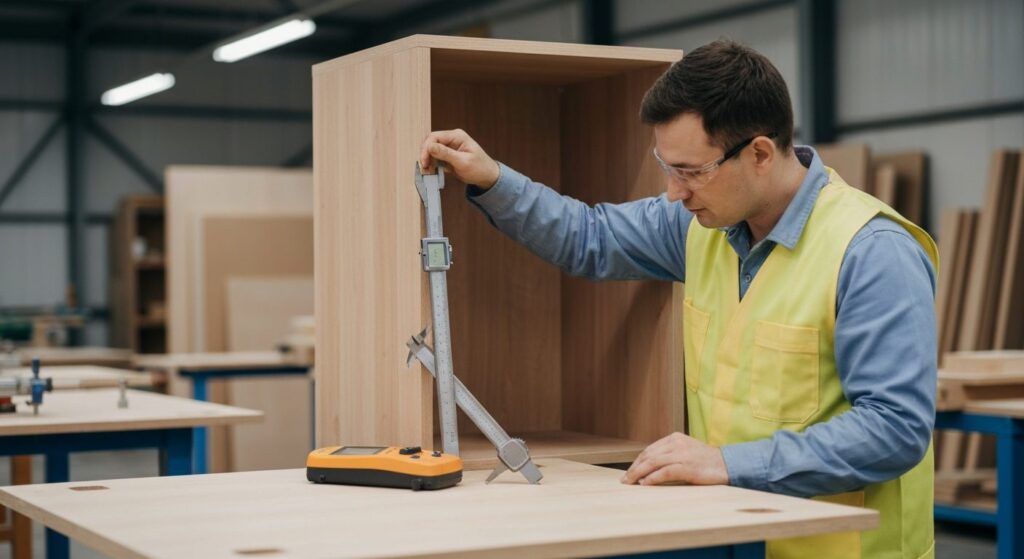
- Dimensional Accuracy: Regularly measuring items to ensure they conform to approved blueprints and tolerances.
- Functionality Testing: For items with moving parts or specific functions (e.g., drawers, doors, reclining mechanisms), testing their operation.
- Golden Sample Comparison: Direct comparison of items from the production line against the pre-approved “golden sample” for aesthetics, finish, and overall quality.
- Defect Identification: Identifying and documenting any emerging defects (e.g., warping, cracking, inconsistent finishes, loose joints) and ensuring corrective actions are implemented immediately.
This ongoing vigilance ensures that quality is built into the product, rather than merely inspected at the end. It allows for adjustments and improvements while production is still active, minimizing the volume of defective goods.
Pre-Shipment Inspection (PSI): The Final Gatekeeper
The Pre-Shipment Inspection (PSI), or pre-shipment inspection Indonesia, is a comprehensive final check performed when 100% of the order is produced and at least 80% is packed. This is the buyer’s last opportunity to confirm that the entire order meets their specifications before departure. As a third party inspection Indonesia service, we conduct this with strict adherence to agreed-upon standards.
- Quantity Verification: Confirming the exact quantity of items produced and packed matches the purchase order.
- Product Specifications: A thorough examination of products against the approved sample, technical drawings, and specifications. This includes:
- Aesthetics: Color, finish consistency, surface defects (scratches, dents).
- Dimensions: Overall measurements and component dimensions.
- Construction and Stability: Strength of joints, assembly, structural integrity.
- Functionality: Testing moving parts, stability tests for chairs/tables.
- Packaging Inspection: Verifying packaging materials, inner packing, and outer cartons are appropriate and provide adequate protection for international transit. This includes checking for correct shipping marks, labels, and barcodes.
- Moisture Content Verification: For solid wood furniture, this is a critical check. Using a calibrated moisture meter, we confirm that the wood’s moisture content is within the target range of 6-8% for conditioned US/EU interiors. We know that moisture content above approximately 12% indicates a serious mold risk and potential for cracking or warping during transit or upon arrival in drier climates.
- AQL Sampling: We apply the Acceptable Quality Limit (AQL) standard for sampling and inspection. This statistical method allows us to determine, with a high degree of confidence, whether the entire batch meets quality requirements without inspecting every single item.
- AQL Levels: Typically, we use General Inspection Level II (GII) for standard consumer goods.
- Defect Classification: Defects are categorized as Critical, Major, or Minor.
- Critical Defects: Zero tolerance. These render the product unusable, unsafe, or non-compliant with regulations (e.g., sharp edges, structural failure, incorrect product). Any critical defect found in the sample will lead to rejection of the entire batch.
- Major Defects: (e.g., AQL 2.5) Significant flaws that impact usability, appearance, or marketability (e.g., large scratches, unstable joints, incorrect finish).
- Minor Defects: (e.g., AQL 4.0) Small imperfections that do not affect usability or marketability but deviate from specifications (e.g., minor blemishes, slight color variation).
A detailed PSI report, complete with photographic evidence, is provided to the buyer, outlining findings, deviations, and recommended actions.
Container Loading Supervision (CLS): Securing Your Shipment
Container Loading Supervision (CLS), or container loading supervision Indonesia, ensures that products are correctly loaded into the container, secured for transit, and that the container itself is fit for international shipping. This final step is vital to prevent damage and delays.
- Container Inspection:
- Cleanliness: Verifying the container interior is free from dirt, debris, and pests.
- Dryness: Checking for any signs of moisture, leaks, or condensation.
- Odor-Free: Ensuring no lingering odors that could contaminate products, especially porous materials like wood or fabric.
- Structural Integrity: Inspecting for holes, damage to walls, floor, or roof.
- Loading Plan Adherence: Supervising the loading process according to a pre-approved loading plan, optimizing space utilization and weight distribution. This prevents shifting during transit.
- Product Protection: Ensuring proper dunnage, strapping, and void fillers are used to secure cartons and furniture pieces.
- Container Sweat Prevention: Strategic placement of desiccants (silica gel packets) within the container to absorb moisture and prevent “container rain” or condensation, which can lead to mold and damage.
- ISPM-15 Compliance: Confirming that all wooden packaging materials (pallets, crates) bear the ISPM-15 stamp, indicating they have undergone appropriate phytosanitary treatment, preventing pest infestations and ensuring smooth customs clearance.
- Seal and Documentation: Witnessing the container sealing with a unique, tamper-proof seal and recording its number. Verifying all necessary shipping documents (packing list, bill of lading, commercial invoice) are prepared.
This meticulous supervision minimizes the risk of damage during transit and ensures compliance with international shipping standards.
Addressing Specific Product Challenges
Indonesia’s diverse product range demands specialized QC approaches. Our expertise covers the unique characteristics of various materials.
Solid Wood Furniture
The primary challenge with solid wood is its susceptibility to changes in moisture content. Our QC focuses on:
- Moisture Content (MC): As noted, target MC is 6-8% for furniture destined for conditioned environments (e.g., US, EU, Australia). We rigorously test this during DUPRO and PSI. MC above ~12% carries a serious mold risk and will lead to warping, cracking, or splitting in drier climates.
- Wood Species Verification: Ensuring the correct timber species (e.g., teak, mahogany, mindi) is used as specified in the order.
- Joinery and Construction: Inspecting the strength and integrity of joints (dovetail, mortise and tenon, dowel) to ensure durability.
- Finish Consistency: Uniformity of staining, lacquering, or oiling across all pieces and surfaces.
Rattan & Natural Fiber Products
Natural fibers require attention to craft and organic material integrity:
- Weave Consistency: Uniformity and tension of weaving patterns in rattan, seagrass, or water hyacinth.
- Color Matching: Ensuring natural variations are acceptable or that dyed colors are consistent batch-to-batch.
- Pest Control: Checking for signs of insects or larvae, especially prior to packing.
- Durability: Assessing the strength of frames and overall construction.
Recycled Teak Furniture
Recycled teak, while sustainable, presents its own set of QC considerations:
- Authenticity: Verifying the timber is genuinely recycled teak and not new wood passed off as reclaimed.
- Stability: Despite being reclaimed, checking for structural integrity, old joinery failures, or excessive cracks that compromise strength.
- Finish Application: Ensuring finishes complement the rustic nature of recycled wood without compromising durability.
- Defect Management: Distinguishing inherent character (e.g., old nail holes, minor imperfections) from actual defects.
Home Decor Items
From ceramics to metalwork, home decor requires a keen eye for detail:
- Material Integrity: Checking for chips, cracks, or deformities in ceramics, glass, or metal.
- Finish Quality: Consistency of paint, glaze, texture, and adherence to design specifications.
- Safety Compliance: Ensuring items meet any specific safety standards for their intended use (e.g., candle holders, wall hangings).
- Packaging: Critical for fragile items, ensuring adequate cushioning and protective measures.
Our Role as Your QC Agent in Indonesia
Engaging Bali Export Broker as your qc agent Indonesia provides a layer of independent oversight. We are not the factory; we are your dedicated third party inspection Indonesia partner, working solely in your interest.
Why a Third Party Inspection is Crucial
Factories often have their own internal QC, but this may lack the objectivity or stringent standards a buyer requires. A third party inspection Indonesia service like ours provides an unbiased assessment, ensuring compliance with your specific requirements, not just the factory’s minimums. We catch issues before they become costly problems across the ocean.
Accountability and Expertise
Our desk oversees the inspection side. Our team is intimately familiar with Indonesian manufacturing processes, common challenges, and international quality standards. We bring this expertise to every inspection, offering actionable insights and problem-solving capabilities. We are accountable for the accuracy of our reports and the integrity of the inspection process.
Beyond Inspection: Problem-Solving and Communication
Our role extends beyond merely reporting defects. We facilitate communication between you and the workshop, explaining issues clearly and proposing practical solutions. We monitor corrective actions, ensuring problems are addressed effectively before shipment. This proactive approach minimizes delays and maintains production schedules.
Timber Legality and Export Documentation
Beyond product quality, compliance with international trade regulations is paramount. Bali Export Broker manages the critical export-documentation and timber-legality paperwork to ensure smooth customs clearance.
SVLK/V-Legal Routing Through Certified Workshops
Indonesia’s Timber Legality Assurance System (SVLK, or Sistem Verifikasi Legalitas Kayu) provides a robust framework for verifying the legality of timber products. While we do not claim SVLK certification as our own, we ensure that all timber products we source and export are routed through SVLK-certified workshops. This means the workshops themselves possess the V-Legal license, guaranteeing that the timber used in your furniture or decor items is legally harvested and processed. We verify the workshop’s certification status and ensure proper documentation is generated for your shipment.
Essential Export Documents
Navigating export documentation is complex. We manage the preparation and verification of key documents:
- HS Codes (Harmonized System Codes): Correct classification of products is vital for customs duties and statistics. We ensure accurate HS codes are applied to your shipment. For example, solid wood furniture often falls under HS codes like 9403.60 (Other wooden furniture).
- COO (Certificate of Origin): This document verifies the country where goods were manufactured, often required for preferential tariff treatment.
- PEB (Pemberitahuan Ekspor Barang): The Indonesian Export Declaration, a mandatory customs document.
- Phytosanitary Certificates: Required for raw wood, plants, or certain natural materials to prevent the spread of pests and diseases.
Our meticulous handling of these documents, alongside SVLK compliance, significantly reduces the risk of your container being held at port. For a more detailed understanding, please refer to our dedicated page on Export Documentation in Indonesia.
Transparent Partnership: Our Service Model
Bali Export Broker operates as a dedicated buying agent. We are a PAID buying agent. Our services are compensated through a transparent commission or service fee, agreed upon upfront with our clients. This model ensures our impartiality and commitment to your best interests. We earn our fee by providing expertise, accountability, and comprehensive quality assurance, not by marking up product prices or receiving undisclosed payments from suppliers.
We firmly believe that true independence and accountability stem from a direct financial relationship with our clients. This clarity allows us to negotiate on your behalf without conflict of interest, ensuring you receive the best possible product at the most competitive price. Our value proposition is the expertise and risk mitigation we provide, allowing you to focus on your business while we manage the complexities of Indonesian sourcing and export.
Key QC Metrics & Standards
To provide clarity on our operational benchmarks, here are some core metrics and standards we apply:
- AQL Sampling (e.g., General Inspection Level II)
-
- Critical Defects: AQL 0 (Zero Tolerance). Any critical defect found leads to immediate batch rejection.
- Major Defects: AQL 2.5 (e.g., for furniture, means 2.5 defective units per 100 inspected are acceptable).
- Minor Defects: AQL 4.0 (e.g., for furniture, means 4.0 defective units per 100 inspected are acceptable).
- Solid Wood Moisture Content Target
- 6-8% for furniture destined for conditioned US/EU interiors. Above ~12% MC poses a serious risk of mold, warping, and splitting. Verified with calibrated moisture meters.
- ISPM-15 Compliance
- Mandatory international standard for all wooden packaging materials (pallets, crates) to prevent pest transmission. Verified by visible stamp.
- Container Cleanliness Standard
- Interior must be visibly clean, dry, odor-free, and structurally sound (no holes, leaks) to prevent product contamination or damage.
- Golden Sample Comparison
- Every inspection stage references the buyer-approved golden sample for aesthetic, dimensional, and material consistency.
Discuss Your QC Needs
Understanding your specific requirements is the first step towards a successful partnership. Whether you are launching a new product line or seeking to improve existing supply chain reliability, our team is ready to assist.
Discuss your QC needs and learn how Bali Export Broker can safeguard your next export from Indonesia. You can also reach out via WhatsApp for a prompt response.
Frequently Asked Questions (FAQs)
What is AQL in quality control?
AQL stands for Acceptable Quality Limit. It is a statistical sampling method used in quality control to determine, with a specified probability, whether a batch of products meets a defined quality standard. Instead of inspecting every single item, a random sample is drawn and inspected. Based on the number of defects found in the sample, the entire batch is either accepted or rejected against pre-defined AQL levels for critical, major, and minor defects.
How do you ensure wood stability and prevent splitting in furniture?
Ensuring wood stability primarily involves controlling its moisture content (MC). We rigorously check MC during raw material intake (IPC), during production (DUPRO), and critically during pre-shipment inspection (PSI). Our target MC for solid wood furniture destined for conditioned environments like the US or EU is 6-8%. Wood with MC significantly above this (e.g., >12%) is at high risk of splitting, warping, or developing mold when exposed to drier climates. We also inspect for proper joinery, wood selection, and drying processes at the workshop level.
What happens if defects are found during an inspection?
If defects are found, we immediately document them with photographic evidence and provide a detailed report to you. For critical defects (AQL 0), the batch is typically rejected, requiring 100% rework or replacement. For major and minor defects exceeding the agreed AQL limits, we work with the factory to implement corrective actions, which may include sorting, rework, or repair. We then conduct a re-inspection to verify that all issues have been satisfactorily addressed before granting approval for shipment.
How long does the quality control process typically take?
The total duration of the quality control process depends on the product type, order volume, and complexity of the manufacturing. A factory audit might take 1-2 days. IPC, DUPRO, PSI, and CLS are typically scheduled at specific points in the production timeline, each lasting from half a day to several days for larger or more complex orders. We work with you to integrate these checks seamlessly into your production lead times, ensuring timely feedback without unnecessary delays.
What is the cost of your QC services?
As a paid buying agent, Bali Export Broker operates on a transparent commission or service fee structure. The cost of our QC services is typically integrated into our overall service fee, which is calculated based on the complexity of the project, the scope of inspections required, and the total value of the order. This fee is always disclosed upfront and agreed upon with you before any engagement. Our fee covers our expertise, on-the-ground presence, detailed reporting, and risk mitigation. For an estimate tailored to your specific needs, please contact us directly.
Bali Export Broker stands as your dedicated partner in complexities of sourcing and exporting from Indonesia. Our commitment to rigorous quality control inspection in Indonesia, transparent practices, and comprehensive documentation ensures that your products meet your standards and arrive as expected. With the Bali Export Broker team, your quality is our priority.
Ready to secure your next Indonesian export with confidence?
Contact us today to discuss your requirements and learn how our accountable QC services can benefit your business. We are also available via WhatsApp for immediate inquiries.