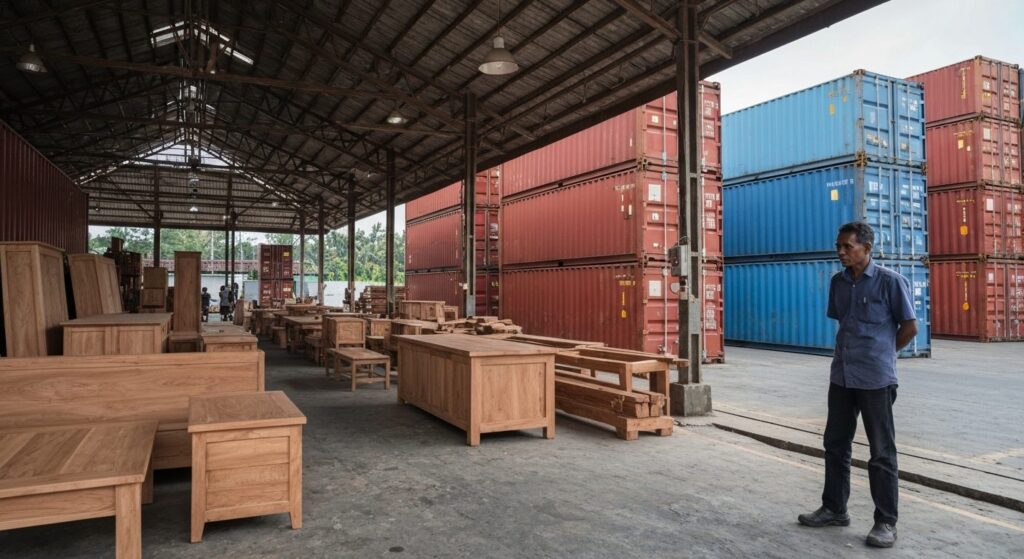
Understanding how a sourcing agent works is critical for importers seeking reliable supply chains from Indonesia. At Bali Export Broker, a division of Juara Holding Group, we offer a structured 8-stage export workflow designed to simplify your procurement of furniture and home decor from Bali and Jepara. Our process integrates supplier identification, quality control, consolidation, and export logistics, providing a single point of contact for your entire import journey.
Our Export & Sourcing desk manages your project end-to-end, taking your initial brief and translating it into a delivered container. Our model is built on transparency: we disclose our service fees upfront and clearly differentiate between categories we export directly and those managed via vetted producer partners. This page outlines our comprehensive approach, detailing each step from initial concept to Incoterms handoff.
Our commitment is to accountability. We do not claim factories, certifications, awards, or commission percentages that we cannot substantiate. This direct, honest approach underpins every transaction and interaction at Bali Export Broker. You gain clarity, control, and consistent quality without the guesswork often associated with international sourcing.
Our Service Model: Direct Export vs. Partner-Matched Categories
At Bali Export Broker, our operational scope is defined by expertise and direct control. This approach ensures consistent quality and accountability for specific product categories. Understanding this distinction is fundamental to how we serve your sourcing needs.
Direct Export Categories: Our Core Competence
For product types where we possess deep, direct operational control and established workshop relationships, we manage the entire export process in-house. This means our team directly oversees production, quality control, consolidation, and all export documentation under the Bali Export Broker umbrella. Our expertise is most pronounced in:
- Furniture: Including indoor, outdoor, and custom-designed pieces.
- Rattan & Natural Fiber Products: Woven furniture, lighting, and decorative items utilizing materials like rattan, bamboo, seagrass, and water hyacinth.
- Recycled Teak Items: Sustainable furniture and decor crafted from reclaimed teak wood.
- General Home Decor: A broad range of decorative items, from artisanal crafts to functional accessories, sourced from our vetted network of Balinese and Jepara workshops.
For these categories, we operate as your primary export desk. Our transparent service fee covers the end-to-end management, ensuring a clear and direct relationship without hidden costs or intermediary markups beyond our agreed commission.
Partner-Matched Categories: Leveraging Specialized Networks
Beyond our direct export categories, we frequently assist buyers with broader sourcing requirements. For items outside our direct operational scope—such as specific textiles, ceramics, or industrial components—we leverage a meticulously vetted network of producer partners. These partners are specialists in their respective fields, holding their own export licenses and operational frameworks.
When you proceed with an order through one of our partner-matched suppliers, we act as a facilitating agent. Our role involves initial supplier identification, basic vetting, and ensuring clear communication. It is important to state plainly: while we do not claim direct control over their production or export processes, we ensure their credibility. If you proceed with our partner, they may pay us a referral fee at no extra cost to you. This model allows us to broaden our service offering while maintaining transparency regarding the operational structure of your order.
This dual approach ensures that whether we are directly exporting or facilitating through partners, you receive transparent information regarding the sourcing and export mechanisms. Our primary goal is to provide an accountable buying agent service that aligns with your specific product needs and risk profile.
The 8-Stage Export Workflow: From Brief to BOL
Our export sourcing workflow is a systematic process designed to provide clarity and control over your order, ensuring consistent quality and timely delivery. Each stage builds upon the last, culminating in a smooth Incoterms handoff.
Stage 1: Sourcing & Supplier Identification
The initial stage of the export sourcing workflow begins with your detailed product brief. This is where we translate your requirements into actionable sourcing parameters. As your buying agent, my team and I focus on understanding your exact specifications, target pricing, material preferences, and design aesthetics.
Briefing and Needs Assessment
We start with a comprehensive discussion to capture every detail of your product vision. This includes technical specifications, desired materials (e.g., reclaimed teak, Grade A rattan, specific timber species like Suar or Trembesi), finishes (e.g., natural oil, matte lacquer), dimensions, and any specific design nuances. We also discuss target pricing, minimum order quantities (MOQs), and your intended market to ensure supplier suitability. Providing detailed CAD drawings, reference images, or physical samples accelerates this process.
Vetted Workshop Matching
Leveraging our extensive network of vetted workshops in Bali and Jepara, we identify manufacturers best suited to your brief. Our network comprises workshops specializing in various materials and production techniques, from traditional hand-carved furniture to modern rattan weaving and recycled teak construction. For direct export categories (furniture, rattan, recycled teak, home decor), we match you with workshops with whom we have established, long-term relationships and direct oversight capabilities.
For categories outside our direct export scope, we identify and introduce you to specialized producer partners, clarifying the operational structure as outlined in our service model. We prioritize workshops with proven track records for quality, ethical labor practices, and production capacity aligned with your order volume. Our initial assessment includes verifying their capability to meet specific certifications if required (e.g., SVLK for timber products, though this is verified in later stages).
This stage concludes with a shortlist of potential suppliers, complete with initial quotes and production timelines based on your specifications. We present these options with a clear breakdown of each workshop’s capabilities and how they align with your project requirements.
Discover more about our specific supplier matching process.
Stage 2: Sample Sourcing & Factory Vetting
Once potential suppliers are identified, the focus shifts to tangible proof of concept and deeper factory assessment. This stage is critical for validating a workshop’s capabilities before committing to full production.
Sample Development and Review
We manage the development of initial samples based on the selected workshop and your refined specifications. This often involves multiple iterations to achieve the desired quality, finish, and design accuracy. For furniture, a sample might be a full-scale prototype; for smaller decor items, multiple units may be produced. Throughout this process, we provide regular photo and video updates, ensuring you are involved at every step.
Our team conducts preliminary quality checks on samples, examining material integrity, construction methods, finishing quality, and dimensional accuracy against your brief. This iterative feedback loop between you, the workshop, and Bali Export Broker ensures the sample meets your expectations before a physical shipment for your final review.
Golden Sample Sign-Off and Factory Audit
Upon your approval of the physical sample, it becomes the “golden sample”—the definitive benchmark for mass production. This sample is stored securely at our facility or the workshop, serving as the immutable standard for all subsequent production and quality control checks. Any deviation from the golden sample during production is flagged and rectified.
Concurrently, we conduct a detailed factory audit for your chosen workshop. This audit assesses:
- Production Capacity: Ability to handle your order volume within specified lead times.
- Quality Control Systems: Internal QC procedures, staff training, and adherence to international standards.
- Equipment & Facilities: Appropriateness and maintenance of machinery and workspace.
- Ethical & Environmental Compliance: Verification of labor practices, safety standards, and environmental responsibility. For timber products, this includes checking initial SVLK documentation or other relevant sustainability certifications, which are fully verified prior to export.
This dual approach of sample validation and factory vetting provides a robust foundation for moving into full-scale production. It de-risks the manufacturing process significantly, ensuring that the selected workshop can consistently deliver to your standards.
Stage 3: Production Supervision / In-line QC
With the golden sample approved and factory vetted, our focus shifts to rigorous oversight of the actual production run. This is where active, on-the-ground management by Bali Export Broker truly adds value.
Continuous Monitoring and Progress Reporting
Our dedicated QC team conducts regular, unannounced visits to the workshop throughout the production cycle. We monitor progress against the agreed timeline, ensuring that raw materials are sourced correctly, and initial production stages adhere to the golden sample’s specifications. For a typical furniture order with an 8-12 week lead time, this involves multiple checkpoints.
We provide you with frequent updates, including detailed photo and video reports, capturing various stages of production. This transparency allows you to track your order’s progress and address any potential issues proactively. We also manage any necessary communication or adjustments with the workshop on your behalf, minimizing language barriers and cultural misunderstandings.
In-line Quality Control Checks
In-line QC is performed at critical stages of production, not just at the end. This proactive approach allows us to identify and rectify defects early, preventing costly rework or batch rejections. Our checks include:
- Raw Material Inspection: Verifying the quality and quantity of incoming materials (e.g., moisture content of wood, grade of rattan, consistency of fabric). For example, ensuring timber moisture content is within 8-12% for indoor furniture, crucial for preventing warping in varied climates.
- Component Inspection: Checking individual parts for defects, dimensional accuracy, and proper assembly during fabrication.
- Workmanship & Finish Inspection: Assessing the quality of joinery, sanding, painting, weaving, and upholstery against the golden sample. This includes examining surface consistency, color matching, and structural integrity.
- Packaging Material Inspection: Ensuring packaging materials meet protective standards (e.g., appropriate thickness of carton, use of foam/bubble wrap).
Any identified non-conformities are immediately addressed with the workshop, and corrective actions are implemented under our supervision. This continuous scrutiny ensures that the entire production batch maintains the quality standard set by the golden sample, minimizing risks before final assembly.
Stage 4: Pre-Shipment Inspection (PSI)
The Pre-Shipment Inspection (PSI) is the final comprehensive quality assurance step before your order is approved for packing and shipment. This critical inspection verifies that the finished goods meet all agreed-upon standards and quantities.
Final Quality Assurance Check
Once production is complete, and the goods are ready for packing, our QC team conducts a thorough PSI. This inspection typically covers a statistically significant sample of the finished products (e.g., using AQL standards like ISO 2859-1, generally Level II, with AQL 2.5 for major defects and 4.0 for minor defects). We inspect:
- Quantity Verification: Cross-checking the actual quantity produced against the purchase order.
- Workmanship & Aesthetics: A final detailed check for any surface defects, scratches, dents, inconsistent finishes, or general aesthetic flaws. Each item is compared directly against the golden sample.
- Functionality & Safety: Testing moving parts, stability of furniture, and any specific safety features. For instance, ensuring drawer slides operate smoothly or chair legs are stable.
- Dimensional Accuracy: Measuring key dimensions to ensure they adhere to specifications, allowing for standard manufacturing tolerances.
- Product Labeling & Markings: Verifying correct branding, labels, barcodes, and any required safety warnings.
We document all findings with detailed reports, including photographs and videos. Any significant defects or non-conformities trigger a ‘hold’ on the shipment until corrective actions are taken and re-inspected. Our goal is to ensure that only products meeting your exact specifications leave the workshop.
Packaging and Labeling Verification
Beyond the product itself, we meticulously inspect the packaging. This includes verifying:
- Protective Packaging: Ensuring items are adequately protected with appropriate materials (e.g., foam, bubble wrap, corner protectors) to withstand transit stresses.
- Outer Carton Quality: Checking the strength and integrity of cardboard boxes, ensuring they are suitable for export.
- Shipping Marks: Confirming all cartons are correctly marked with shipping information, item codes, quantity, gross/net weight, and destination details as per your instructions. This is crucial for efficient customs clearance and warehouse management upon arrival.
- Assembly Instructions & Hardware: For flat-pack or assembly-required items, we verify that all necessary hardware and clear instructions are included within each package.
The PSI provides a final layer of assurance, minimizing the risk of receiving damaged, incorrect, or sub-standard goods upon arrival. Once the PSI is successfully completed and approved by you, the goods are cleared for the next stage: consolidation.
Learn more about our robust QC inspection services.
Stage 5: Multi-Workshop Consolidation
For importers sourcing various products from multiple workshops across Bali and Jepara, consolidation is an indispensable service. It optimizes container space, reduces shipping costs, and streamlines logistics.
Centralized Collection and Inventory Management
Our dedicated warehouse facilities in Bali serve as the central hub for collecting goods from all your approved workshops. As items complete their Pre-Shipment Inspection and are ready for dispatch, our team arranges for their secure transport from individual workshops to our consolidation point. This eliminates the need for you to coordinate multiple pickups or manage fragmented logistics.
Upon arrival at our warehouse, each item is meticulously checked against its packing list, photographed, and entered into our inventory system. We verify quantities, item codes, and packaging integrity. This centralized inventory management provides a clear overview of all your goods, ensuring nothing is missed and enabling efficient container planning. Our facilities are equipped for secure short-term storage, allowing flexibility in your shipping schedule.
Optimizing Container Space and Logistics
Once all items are gathered, our logistics team plans the most efficient loading strategy for your container. This involves calculating volumetric weight (CBM) and physical weight (kg) for each item and arranging them to maximize container utilization. For example, a standard 20ft container typically holds 28-30 CBM, while a 40ft container holds 58-60 CBM. Strategic packing can significantly impact your freight costs.
We provide you with a detailed consolidation report, including:
- A consolidated packing list detailing all items, quantities, dimensions, and weights.
- A proposed container loading plan, often with diagrams, to illustrate how items will be arranged.
- An estimated total CBM and gross weight for the entire shipment.
This meticulous planning not only saves you money on freight but also ensures that fragile items are protected and accessible during unloading at your destination. Our consolidation service is designed to transform a complex multi-vendor order into a single, manageable shipment.
Explore our container consolidation solutions.
Stage 6: Container Loading & Loading Supervision
The loading of the container is a critical juncture where proper execution directly impacts the condition of your goods upon arrival. Our supervision ensures items are loaded securely and efficiently.
Strategic Container Packing
On the scheduled loading day, a Bali Export Broker supervisor is present at our warehouse or the designated loading site. The supervisor directs the loading team, ensuring that the pre-approved loading plan is strictly followed. This involves:
- Weight Distribution: Ensuring even weight distribution within the container to maintain balance and prevent shifting during transit. Heavy items are typically loaded at the bottom and front.
- Protection of Fragile Items: Implementing extra protective measures for delicate goods, such as placing them in designated, secure areas, using dunnage, or reinforcing with additional padding.
- Space Optimization: Utilizing every available cubic meter effectively, while ensuring stability and preventing damage from movement.
- Securing the Load: Using straps, airbags, and wooden bracing (lashing) to prevent items from shifting or collapsing during sea transit, which can involve significant motion.
Our supervisor meticulously documents the entire loading process with extensive photographs and videos, which are then shared with you. This visual record provides transparency and serves as proof of careful handling.
Final Seal and Documentation
Once the container is fully loaded and secured, the container doors are closed and sealed with a unique, tamper-proof shipping seal. The seal number is recorded on the Bill of Lading (BOL) and other export documents, providing an unbroken chain of custody.
Before the container departs for the port, our supervisor verifies that all necessary paperwork, including the packing list and any specific loading instructions, are finalized. This meticulous oversight at the loading stage significantly mitigates the risk of cargo damage, shortages, or discrepancies, ensuring your shipment is ready for international transit with confidence.
Stage 7: Export Documentation
complexities of international export documentation is a core service we provide, ensuring compliance and smooth customs clearance at both origin and destination.
Preparation of Commercial and Legal Documents
Our export team is responsible for preparing all necessary commercial and legal documents required for exporting from Indonesia. This includes:
- Commercial Invoice: Detailing the goods, quantities, unit prices, and total value of the shipment. This is crucial for customs valuation and duties.
- Packing List: An itemized list of all goods in the shipment, including their dimensions, weights (net and gross), and how they are packed. This aids in customs inspection and inventory management.
- Bill of Lading (BOL): Issued by the shipping carrier, serving as a contract of carriage, a receipt for goods, and a document of title. It specifies the shipper, consignee, cargo details, and destination.
- Certificate of Origin (COO): Verifying that the goods were manufactured in Indonesia, which can be important for preferential tariffs or trade agreements in the destination country.
- Fumigation Certificate: If wooden packaging materials are used, this certificate confirms they have been treated to prevent pest contamination, as per international phytosanitary standards (ISPM 15).
- SVLK Certificate (Sistem Verifikasi Legalitas Kayu): For timber and wooden products, this certificate verifies the legality of the timber source, ensuring it is harvested sustainably and ethically. This is a mandatory requirement for exporting timber products from Indonesia to certain markets.
We ensure all documents are accurate, consistent, and comply with both Indonesian export regulations and the import requirements of your destination country. Any discrepancies can lead to significant delays and penalties, which we proactively prevent through rigorous review.
Customs Clearance and Compliance
Once all documentation is prepared, we manage the customs clearance process in Indonesia. This involves submitting the necessary documents to the Indonesian customs authorities (Bea Cukai) and coordinating any required inspections or declarations. Our team is well-versed in local regulations, including HS codes (Harmonized System codes) for various furniture and home decor items (e.g., 9403.60 for wooden furniture, 9403.89 for rattan furniture, 4601.21 for woven products of rattan). Correct HS codes are vital for accurate duty assessment and smooth clearance.
We act as the liaison between you, the workshops, and the customs authorities, ensuring all procedures are followed correctly and efficiently. Our goal is to secure swift customs approval, allowing your shipment to proceed to its international freight stage without undue complications.
For more on our export documentation expertise.
Stage 8: Freight Booking & Incoterms Handoff
The final stage in our workflow involves securing international freight and managing the Incoterms handoff, bringing your goods from our facility to your designated port or location.
International Freight Booking and Coordination
We leverage our established relationships with reputable shipping lines and freight forwarders to secure competitive rates and reliable transit times for your shipment. Whether you require FCL (Full Container Load) or LCL (Less than Container Load) services, we handle the booking and coordination. Our expertise spans various shipping routes, primarily connecting Indonesian ports (e.g., Tanjung Perak in Surabaya, Tanjung Emas in Semarang, Tanjung Priok in Jakarta) to major global destinations.
We provide you with detailed shipping schedules, vessel tracking information, and estimated arrival times. Our team monitors the shipment’s progress, proactively communicating any potential delays or changes in transit. We aim for transparency in all freight arrangements, ensuring you have a clear understanding of costs and timelines.
Incoterms Handoff and Post-Shipment Support
The Incoterms (International Commercial Terms) define the responsibilities of the buyer and seller for the delivery of goods, risk transfer, and costs. We work with common Incoterms such as:
- FOB (Free On Board): We deliver the goods on board the vessel nominated by you at the agreed port of shipment in Indonesia. Risk and cost transfer to you once goods are on board.
- EXW (Ex Works): Goods are made available at our warehouse or the workshop. You bear all costs and risks from that point.
- CIF (Cost, Insurance, and Freight): We cover the cost of goods, insurance, and freight to your designated port of destination. Risk transfers once goods are on board, but we arrange and pay for insurance and freight.
- DDP (Delivered Duty Paid): We handle all costs and risks, including duties and taxes, until the goods are delivered to your specified destination address. This is the highest level of responsibility for us.
The Incoterms handoff marks the completion of our primary service scope. However, our support doesn’t end there. We provide post-shipment assistance, including forwarding all original shipping documents (BOL, Commercial Invoice, Packing List, Certificates) to your freight forwarder or directly to you, enabling smooth customs clearance at your destination. We remain available to answer any questions or address any issues that may arise during the final leg of your shipment’s journey.
Through this comprehensive 8-stage workflow, Bali Export Broker provides a structured, transparent, and accountable pathway for sourcing and exporting furniture and home decor from Indonesia. Our service operates on a transparent commission model, ensuring our expertise and oversight are fully aligned with your success.
Ready to streamline your import process? Plan your trip with Bali Export Broker today. We can also assist with initial consultations via WhatsApp to discuss your specific sourcing needs.
- Service Model Comparison: Bali Export Broker
-
Feature Direct Export (Furniture, Rattan, Recycled Teak, Home Decor) Partner-Matched (Other Categories) Operational Control Bali Export Broker directly manages end-to-end (sourcing, QC, consolidation, export). Vetted producer partner manages production & export; Bali Export Broker facilitates. Commission/Fee Structure Transparent service fee/commission disclosed upfront, paid directly to Bali Export Broker. Producer partner may pay Bali Export Broker a referral fee at no extra cost to buyer. Quality Control Oversight Full, in-depth QC by Bali Export Broker’s dedicated team (in-line, PSI, loading). Initial vetting of partner’s QC capabilities; primary QC by partner. Export Documentation Prepared and managed directly by Bali Export Broker. Prepared by producer partner; Bali Export Broker verifies for completeness. Risk Management Maximized mitigation through direct oversight and accountability. Mitigated by partner vetting; primary operational risk held by partner. Transparency Complete transparency on costs, processes, and factory relations. Transparent disclosure of partner relationship and referral fee structure. Typical Lead Time (Production) 8-12 weeks for custom furniture (last verified June 2026). Varies by partner and product type (e.g., 4-16 weeks, last verified June 2026).
Frequently Asked Questions About Sourcing Agents
How does a sourcing agent earn money?
A sourcing agent, such as Bali Export Broker, earns money through transparent service fees or commissions. For direct export categories like furniture and home decor, we charge a pre-agreed commission or service fee directly to the buyer, covering our end-to-end management, QC, and logistics. For categories managed via vetted producer partners, our partners may pay us a referral fee, which is at no additional cost to you, the importer. This model ensures our interests are aligned with securing quality products and efficient processes for you.
What is the typical lead time for furniture production in Indonesia?
For custom furniture and larger orders from Bali and Jepara workshops, the typical production lead time ranges from 8 to 12 weeks. This can vary based on the complexity of the design, material availability, current workshop load, and the specific time of year (e.g., pre-holiday periods may extend timelines). Our 8-stage workflow helps manage these timelines effectively, with continuous production supervision and reporting.
Do you handle LCL (Less than Container Load) shipments?
Yes, Bali Export Broker handles both FCL (Full Container Load) and LCL (Less than Container Load) shipments. Our multi-workshop consolidation service is particularly beneficial for LCL shipments, allowing you to combine goods from various suppliers into a single, cost-effective shipment. We optimize container space and manage all necessary logistics, regardless of your shipment volume.
How do you ensure product quality and ethical sourcing?
Our commitment to quality and ethical sourcing is integrated into every stage of our 8-stage workflow. This includes rigorous factory vetting, continuous in-line quality control checks during production, a comprehensive Pre-Shipment Inspection