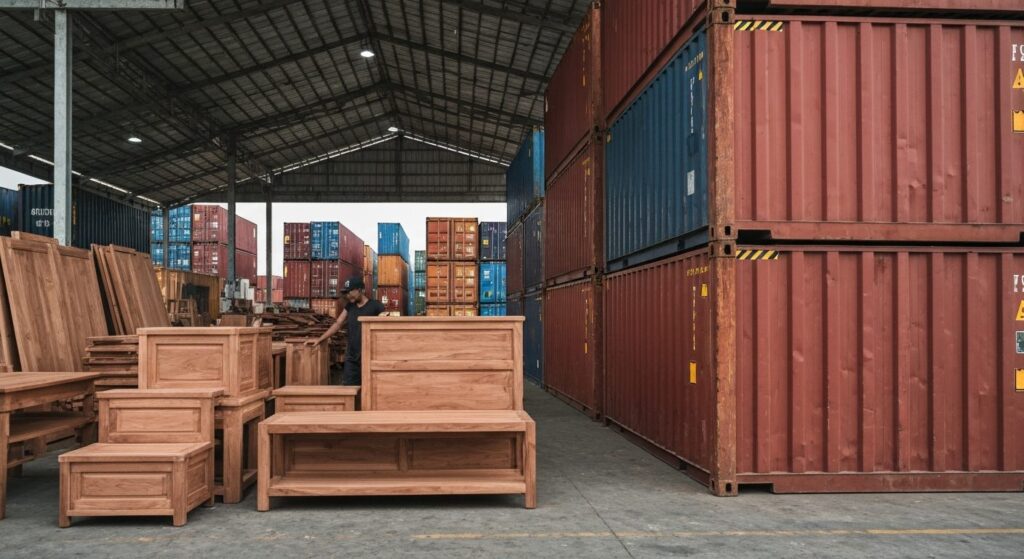
As the Logistics & Freight desk at Bali Export Broker, we regularly address the foundational question for furniture importers: how many chairs fit in a 40HC container? While the precise number varies significantly based on item dimensions, packaging, and loading strategy, a standard 40-foot High Cube (40HC) container offers approximately 76.3 Cubic Meters (CBM) of nominal capacity, though practical utilization typically ranges from 85% to 90%.
Understanding container capacity is the first step in efficient furniture export from Indonesia. Our role involves transforming a collection of diverse workshop goods into a meticulously packed, fully documented, and compliant container shipment ready for global transit. From crating supervision in Bali or Jepara to navigating port logistics through Surabaya, Semarang, or Benoa, every cubic meter counts.
Understanding Container Capacities for Furniture Export
Efficient container loading starts with a clear understanding of the capacities available. While nominal CBM figures provide a theoretical maximum, real-world loading, especially for furniture, demands a more practical approach, accounting for packaging, item shapes, and necessary internal bracing.
Standard Container Dimensions and Practical CBM
Here’s a breakdown of the most common container types used for international freight, along with their nominal and practical CBM capacities:
- 20-foot General Purpose (20ft GP) Container:
-
- External Dimensions: 6.06m (L) x 2.44m (W) x 2.59m (H)
- Internal Dimensions (Approx.): 5.89m (L) x 2.35m (W) x 2.39m (H)
- Nominal CBM: Approximately 33.2 CBM
- Practical Loading Capacity: Typically 28-30 CBM (85-90% utilization)
- Maximum Payload: Varies by carrier and specific container, often around 28,000 kg.
- 40-foot General Purpose (40ft GP) Container:
-
- External Dimensions: 12.19m (L) x 2.44m (W) x 2.59m (H)
- Internal Dimensions (Approx.): 12.03m (L) x 2.35m (W) x 2.39m (H)
- Nominal CBM: Approximately 67.6 CBM
- Practical Loading Capacity: Typically 57-61 CBM (85-90% utilization)
- Maximum Payload: Varies, often around 26,000 kg.
- 40-foot High Cube (40HC) Container:
-
- External Dimensions: 12.19m (L) x 2.44m (W) x 2.89m (H)
- Internal Dimensions (Approx.): 12.03m (L) x 2.35m (W) x 2.69m (H)
- Nominal CBM: Approximately 76.3 CBM
- Practical Loading Capacity: Typically 65-69 CBM (85-90% utilization)
- Maximum Payload: Varies, often around 26,000 kg (similar to 40ft GP, as the added height mostly affects volume, not weight capacity).
The 40HC container is often preferred for furniture shipments due to its increased height, offering a significant volume advantage over the standard 40ft GP container without a substantial increase in cost or footprint. The “practical loading capacity” acknowledges the realities of irregular shapes, necessary dunnage (packaging materials, bracing), and ergonomic considerations during loading.
Factors Affecting Container Loading Efficiency for Furniture
Optimizing how much furniture in a container involves more than just CBM calculations. Several critical factors influence the final loadout:
- Item Dimensions and Shape: A perfectly rectangular item will always pack more efficiently than an irregularly shaped one. Curved armchairs, for instance, leave more void space than stackable dining chairs.
- Packaging: The type and thickness of packaging (e.g., single-layer carton, multi-layer carton, wooden crate, foam wrap) add to the overall volume of each item. Robust packaging is essential for protecting goods but consumes space.
- Nesting and Disassembly: Furniture designed to nest (e.g., stools, some tables) or disassemble (e.g., bed frames, flat-pack shelves) significantly reduces individual CBM, allowing more pieces to fit.
- Mixed Goods Consolidation: When loading a container with diverse items—chairs, tables, cabinets, baskets—strategic planning is essential. Heavier, sturdier items typically form the base, with lighter, more fragile items placed on top or in gaps. This is where Bali Export Broker’s expertise in container loading furniture CBM becomes invaluable.
- Weight Distribution: Proper weight distribution prevents shifting during transit and ensures the container remains balanced, which is critical for safety and compliance. While volume is often the primary concern for furniture, weight limits (payload) must still be respected.
Calculating CBM for Your Furniture
To accurately estimate how many chairs fit in a 40HC container, you must first determine the CBM of each individual item. This calculation is straightforward.
Step-by-Step CBM Calculation
- Measure Item Dimensions: Obtain the length (L), width (W), and height (H) of your item after it has been fully packaged for export. Use meters (m) for consistency.
- Example: A packaged dining chair measures 0.5m (L) x 0.5m (W) x 1.0m (H).
- Multiply Dimensions: CBM = Length (m) x Width (m) x Height (m).
- Example: 0.5m x 0.5m x 1.0m = 0.25 CBM per chair.
- Account for Irregular Shapes: For items that aren’t perfect cuboids (e.g., a vase in a box), measure the dimensions of the smallest rectangular box that can contain the packaged item.
- Total CBM for Multiple Items: Multiply the individual item CBM by the quantity.
- Example: 100 chairs x 0.25 CBM/chair = 25 CBM total.
Illustrative CBM Examples for Common Furniture Types
Let’s consider a few common furniture items from Bali and Jepara workshops to illustrate CBM calculations:
- Dining Chair (packaged): 0.5m L x 0.5m W x 1.0m H = 0.25 CBM
- Armchair (packaged): 0.8m L x 0.8m W x 0.9m H = 0.576 CBM
- Small Coffee Table (disassembled, flat-packed): 0.7m L x 0.7m W x 0.15m H = 0.0735 CBM
- Large Coffee Table (assembled, crated): 1.2m L x 0.8m W x 0.45m H = 0.432 CBM
- Rattan Basket (large, unpackaged, but stackable): 0.6m diameter x 0.5m H. If nested, the CBM will be significantly lower per unit. If not, treat as a cube: 0.6m L x 0.6m W x 0.5m H = 0.18 CBM.
- Wardrobe (disassembled, flat-packed in multiple cartons): This would be a sum of several cartons. For example, two cartons: Carton 1 (1.8m L x 0.6m W x 0.1m H = 0.108 CBM) + Carton 2 (0.9m L x 0.5m W x 0.15m H = 0.0675 CBM) = 0.1755 CBM total.
These figures are illustrative. Actual dimensions will vary by design and specific packaging.
How Many Chairs Fit in a 40HC Container? Practical Scenarios
Now, let’s apply the practical 40ft high cube CBM capacity of approximately 65-69 CBM to various chair types. This will give you a realistic expectation of how many chairs fit in a 40HC container.
Scenario 1: Standard Dining Chairs (Non-Nesting)
- Chair Type: Standard wooden dining chair, fully assembled, individually wrapped/cartoned.
- Packaged Dimensions: 0.5m L x 0.5m W x 1.0m H = 0.25 CBM per chair.
- Calculation:
- Using a practical 40HC capacity of 67 CBM:
- 67 CBM / 0.25 CBM/chair = 268 chairs.
- Considerations: Even with uniform chairs, gaps will occur. Stacking chairs (if designed for it) can reduce height and improve density. Some chairs might be able to be loaded upside down or on their sides to better utilize space.
Scenario 2: Stackable Dining Chairs
- Chair Type: Dining chairs designed to stack, significantly reducing height when nested. Often shipped in stacks of 2-4.
- Packaged Dimensions (Stack of 2): Let’s assume two chairs stack to 1.5m H. So, 0.5m L x 0.5m W x 1.5m H = 0.375 CBM for two chairs. This means 0.1875 CBM per chair.
- Calculation:
- Using 67 CBM practical capacity:
- 67 CBM / 0.1875 CBM/chair = 357 chairs.
- Considerations: This illustrates the significant advantage of stackable designs. The challenge lies in securing the stacks to prevent damage.
Scenario 3: Upholstered Armchairs
- Chair Type: Comfortable upholstered armchairs, typically non-stackable, requiring robust individual packaging.
- Packaged Dimensions: 0.8m L x 0.8m W x 0.9m H = 0.576 CBM per armchair.
- Calculation:
- Using 67 CBM practical capacity:
- 67 CBM / 0.576 CBM/armchair = Approximately 116 armchairs.
- Considerations: The bulkier nature of armchairs means fewer units fit. Careful planning is needed to fill void spaces with smaller items if possible, or to ensure adequate bracing.
Scenario 4: Bar Stools (Disassembled)
- Chair Type: Bar stools, often shipped disassembled in flat-pack cartons.
- Packaged Dimensions (per stool carton): 0.4m L x 0.4m W x 0.15m H = 0.024 CBM per stool.
- Calculation:
- Using 67 CBM practical capacity:
- 67 CBM / 0.024 CBM/stool = Approximately 2,791 stools.
- Considerations: While theoretically high, the weight limit of the container might become a factor here before volume, especially for solid wood or metal stools. Also, the sheer number requires meticulous inventory and loading management.
These examples clearly demonstrate that the answer to “how many chairs fit in a 40HC container?” is highly variable. Precise planning based on your specific product dimensions and packaging is non-negotiable.
Optimizing Container Loading for Mixed Furniture Shipments
Rarely does a client order only one type of chair. Most FCL (Full Container Load) shipments handled by Bali Export Broker are consolidations of mixed workshop goods. This is where the art and science of container loading truly come into play, maximizing 40hc container capacity furniture.
Strategies for Maximizing Space
- Strategic Placement: Heavy, sturdy items (e.g., dining tables, cabinets) should form the base of the load. Lighter, more fragile items (e.g., mirrors, delicate decor) are packed on top or in upper voids, carefully braced.
- Void Filling: Use smaller, flexible items like decorative baskets, cushions, or textiles to fill irregular gaps between larger pieces. This not only utilizes space but also helps brace the main cargo.
- Vertical Stacking: Where possible and safe, items are stacked to utilize the full height of the 40HC container. Proper dunnage (cardboard sheets, foam, plywood) is used between layers to distribute weight and prevent damage.
- Disassembly and Flat-Packing: Encourage suppliers to disassemble furniture whenever feasible. A flat-packed bed frame takes a fraction of the space of an assembled one. My team supervises this to ensure all hardware is included and clearly labeled.
- Custom Crating: For valuable or fragile items, custom wooden crates are built. While crates add CBM, they offer superior protection. We ensure crates are designed to fit container dimensions efficiently, minimizing wasted space.
- Door-Side Access: Items needed first at the destination (or items that might cause access issues) are loaded last, near the container doors.
FCL vs. LCL: Deciding Your Best Option
The decision between Full Container Load (FCL) and Less than Container Load (LCL) hinges on your shipment volume and urgency.
-
FCL (Full Container Load):
- Volume: Ideal when your goods fill a significant portion of a 20ft, 40ft, or 40HC container (typically >15-20 CBM for a 20ft, or >30-40 CBM for a 40ft/40HC).
- Cost: Generally more cost-effective per CBM than LCL once a certain volume threshold is met. You pay for the entire container.
- Transit Time: Often faster and more direct, as the container is sealed at the origin and typically not opened until the destination.
- Handling: Less handling, reducing the risk of damage.
- Our Role: For FCL, we oversee everything from crating and loading supervision at the workshop/warehouse, to freight booking through our network, to managing all export documentation and providing destination-side duty and compliance guidance for markets like the USA, EU, and Australia.
-
LCL (Less than Container Load):
- Volume: Suitable for smaller shipments, typically less than 15-20 CBM. Your goods share container space with other importers’ cargo.
- Cost: You pay only for the volume and weight your goods occupy. However, per-CBM rates can be higher due to consolidation fees, deconsolidation fees, and minimum charges.
- Transit Time: Can be slower due to the need for consolidation at the origin port (Surabaya, Semarang, Benoa) and deconsolidation at the destination port.
- Handling: More handling due to multiple loading/unloading points.
- Our Role: For LCL, we still manage the collection from workshops, consolidation at a reputable freight forwarder’s warehouse, export documentation, and destination guidance. We ensure your smaller shipment integrates smoothly into the larger logistics chain.
For clients looking to fill a 40HC container with furniture, FCL is almost always the most logical and economical choice. It provides maximum control, security, and often, faster transit.
Our Role: Turning Goods into Global Shipments
As the Logistics & Freight Lead at Bali Export Broker, our team are the bridge between your sourced products and their final destination. My focus is on meticulous execution after your goods leave the workshop.
Comprehensive Logistics Management
- Crating & Container-Loading Supervision: This is where the rubber meets the road. We or through my trained team supervise every container loading. We ensure items are correctly identified, properly packaged, strategically placed, and securely braced within the container to prevent movement and damage during the ocean voyage. This includes documenting the loading process with photographs and detailed packing lists.
- FCL (20ft, 40ft, 40HC) and LCL Options: Based on your order volume, we advise on and arrange the most suitable container type. For larger furniture orders, the 40HC container is a frequent choice due to its optimal balance of volume and cost.
- Port Routing Expertise: We route your shipments through the most efficient Indonesian ports for furniture export: Surabaya, Semarang, or Benoa. The choice depends on the workshop’s location, the specific shipping line availability, and the final destination to optimize transit time and cost.
- Freight Booking: Leveraging our established relationships with reputable shipping lines, we secure competitive freight rates and reliable schedules. We handle all bookings, ensuring timely departure and accurate vessel information.
- Export Documentation: Navigating Indonesian export regulations and international shipping paperwork can be complex. We prepare all necessary documentation, including Bills of Lading, Commercial Invoices, Packing Lists, Certificates of Origin, and any specific permits required for your product category.
- Destination-Side Duty & Compliance Guidance: Once your container is en route, our support doesn’t end. We provide guidance on destination-side duties, taxes, and compliance requirements for key markets such as the USA, the European Union, and Australia. This foresight helps you avoid costly delays and unexpected fees upon arrival. We operate as your accountable buying agent, ensuring that the transition from a warehouse of mixed-workshop goods to one clean, documented, loaded container is seamless.
Our Transparent Service Model
At Bali Export Broker, we operate on a model of full transparency and accountability. We provide comprehensive sourcing, quality control, consolidation, export documentation, and logistics services. For these services, Bali Export Broker charges a transparent service fee or commission, clearly communicated to our clients upfront. This fee covers our extensive expertise, the diligent work of our team in managing your orders from multiple workshops, ensuring quality, supervising loading, handling complex documentation, and providing end-to-end logistics support. Our value proposition is rooted in providing a single, accountable point of contact for your Indonesian export needs, ensuring quality and minimizing risk for your business. We believe in direct, honest communication about our operational structure and how we deliver value.
If you’re planning a large furniture import from Indonesia and need to understand the specifics of container loading, including how much furniture in a container or the optimal use of 40ft high cube CBM, we can help. Our team can provide tailored CBM calculations and loading plans for your specific product mix.
Plan your trip to Indonesia with Bali Export Broker to discuss your export needs. Reach out to us via our contact page, or message us on WhatsApp for a direct discussion about your upcoming shipment.
Frequently Asked Questions
What is the difference between a 40ft container and a 40HC container?
The primary difference is height. A standard 40ft General Purpose (GP) container has an external height of 2.59 meters (8.5 feet), offering a nominal capacity of approximately 67.6 CBM. A 40ft High Cube (HC) container has an external height of 2.89 meters (9.5 feet), providing an additional foot of vertical space and a nominal capacity of approximately 76.3 CBM. This extra height makes the 40HC ideal for voluminous cargo like furniture, allowing more items to be stacked or taller pieces to fit.
What is practical loading capacity, and why is it lower than nominal CBM?
Nominal CBM is the theoretical maximum volume inside a container. Practical loading capacity, typically 85-90% of nominal CBM, accounts for real-world constraints. These include the irregular shapes of packaged goods, the need for protective packaging (which adds bulk), internal bracing and dunnage to secure cargo, and ergonomic limitations during the loading process. It’s the realistic volume you can expect to utilize effectively.
Can Bali Export Broker help with mixed container loading from multiple suppliers?
Yes, absolutely. Consolidating goods from various workshops is a core service at Bali Export Broker. We manage collections from different suppliers across Bali and Jepara, bring them to our warehouse, oversee quality control, and then meticulously plan and supervise the loading of these mixed goods into a single container. This ensures efficient use of space and comprehensive documentation for all items.
How do I get an accurate quote for shipping a 40HC container of furniture?
To get an accurate quote, we need specifics: a detailed packing list with the dimensions (L x W x H in meters) and weight (kg) of each packaged item, the total quantity of each item, the origin workshop location(s) in Indonesia, and the final destination port or city. With this information, we can calculate the total CBM and weight, determine the most suitable container and routing, and then provide a comprehensive freight estimate. Pricing for freight services is dynamic; we will provide ranges flagged “last verified June 2026” to reflect market conditions.
What Incoterms does Bali Export Broker typically use for furniture exports?
We work with a range of Incoterms based on client preference and specific needs. Common Incoterms for furniture exports from Indonesia include FOB (Free On Board), where we handle costs and risks up to loading onto the vessel at the port of origin (e.g., Surabaya, Semarang, Benoa), and CIF (Cost, Insurance, and Freight), where we cover costs and insurance to the named port of destination. We also facilitate EXW (Ex Works) if the client prefers to manage all logistics from the factory gate. We will discuss the implications of each Incoterm to ensure you select the one best suited for your business model.