How we work, plainly: Bali Export Broker is the sourcing & export desk of the same Indonesian furniture and home-decor exporter behind baliteakfurniture.com, under Juara Holding Group. We act as your buying agent and earn a disclosed commission or service fee agreed per project — we are not unpaid and not a “free” agent. Furniture, rattan/natural-fiber, recycled teak and home decor we source and export directly; every other category we match via vetted producer partners and say so. SVLK/V-Legal, FSC and similar documents are issued by certified workshops and accredited bodies, not by us. Figures (HS codes, container volumes, lead times) are general references; final scope and pricing are by quote.
Jepara furniture sourcing involves procuring wood and natural fiber furniture from the established manufacturing hub located on the north coast of Java, approximately 100 kilometers northeast of Semarang. This region, historically a woodcarving center for over four centuries, transformed into a global furniture-export hub during the 1990s, specializing in items crafted from teak, mahogany, and rattan.
As the Quality Control & Compliance Lead at Bali Export Broker, my role is to ensure that every piece of furniture sourced from Jepara meets the buyer’s specifications and complies with international export regulations. Our desk provides a direct, accountable buying agent service for importers seeking reliable supply chains for Indonesian furniture and home decor. This guide outlines the specifics of sourcing furniture from Jepara and how our operational model safeguards your investment.
The Unique Heritage and Industrial Strength of Jepara
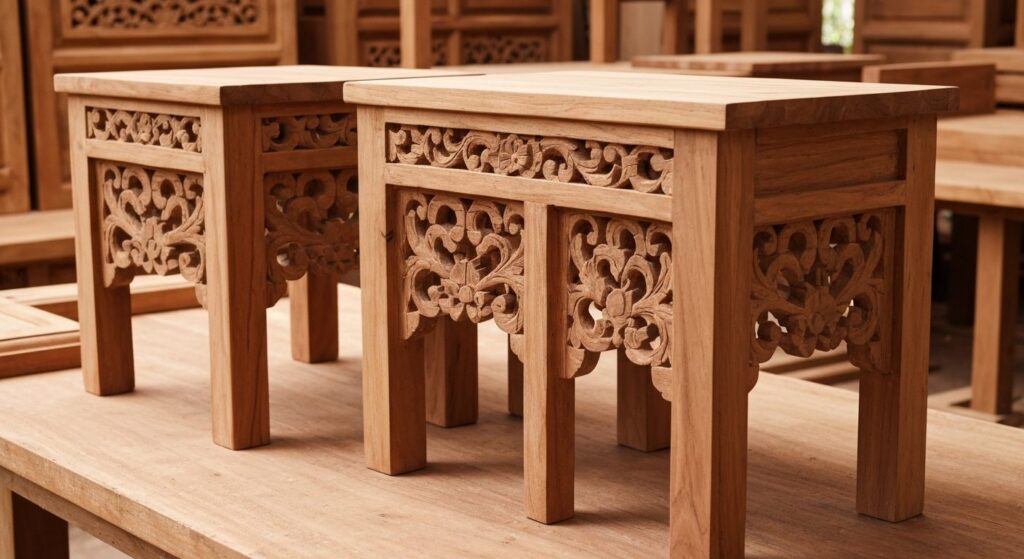
Jepara’s prominence in furniture manufacturing is rooted in a rich history of craftsmanship. The local woodcarving tradition, distinct from other Indonesian regions, primarily depicts intricate patterns of flowers, leaves, and vines, deliberately avoiding human or animal forms. This aesthetic is deeply embedded in the region’s cultural identity and is evident in many of the handcrafted pieces produced there.
Geographically, Jepara’s proximity to Semarang, specifically the Tanjung Emas port, provides a natural and efficient gateway for export. This strategic location, combined with generations of skilled artisans and abundant raw material access, has solidified Jepara’s position as a central Java furniture hub for global markets. The area is dense with workshops, ranging from small family-run operations to larger, more industrialized factories, each contributing to the diverse range of products available for export.
A Legacy of Teak and Craftsmanship
Teak (Tectona grandis) is synonymous with Jepara. Its durability, natural resistance to pests and moisture, and attractive grain make it a preferred material for both indoor and outdoor furniture. The region benefits from access to Indonesian government-managed teak plantations, ensuring a steady, if regulated, supply. Beyond teak, workshops in Jepara also work extensively with mahogany, mindi wood, and various natural fibers like rattan, water hyacinth, and seagrass, expanding the product portfolio for importers.
What to Source in Jepara: Product Categories and Materials
Jepara is renowned for specific categories of furniture and home decor. Understanding these specializations is key to effective sourcing.
Solid Wood Furniture
The primary offering from Jepara workshops is solid wood furniture. This includes:
- Teak Furniture: Outdoor settings (dining sets, loungers, benches), indoor dining tables, chairs, cabinets, and beds. Teak’s inherent properties make it suitable for enduring diverse climates.
- Recycled Teak Furniture: A sustainable option, utilizing reclaimed teak wood from old buildings, boats, or railway sleepers. Each piece often carries unique character from its previous life, with visible grain variations and occasional repair patches.
- Mahogany Furniture: Often used for indoor pieces requiring a smoother finish and a darker, more uniform appearance. It is frequently carved or turned for classic and contemporary designs.
- Mindi Wood Furniture: A lighter-colored wood, often stained to resemble other timbers. It offers a good balance of durability and workability, suitable for a range of indoor furniture items.
Natural Fiber Furniture and Decor
While wood is dominant, Jepara workshops also produce significant volumes of natural fiber products, often combining them with wooden frames:
- Rattan Furniture: Woven chairs, sofas, tables, and decorative items. Rattan is lightweight, flexible, and strong, making it versatile for various designs.
- Water Hyacinth & Seagrass: Used for weaving decorative accents, storage baskets, and sometimes applied to furniture frames for textural interest.
Home Decor and Accents
Beyond large furniture pieces, Jepara workshops can produce smaller wooden decor items, carvings, and sometimes mirrors or lamps with wooden frames. Our sourcing focus for Jepara remains primarily on furniture and related natural fiber products, reflecting the region’s core competencies.
Our Sourcing Process: Accountability from Workshop to Container
Bali Export Broker operates as your accountable buying agent. For furniture, rattan/natural-fiber, recycled teak, and home decor sourced from vetted Bali/Jepara workshops, we manage the entire process directly. For other categories, we commission-match via vetted producer partners, stating this plainly. We never claim a factory, certification, award, or commission percentage we cannot prove.
1. Supplier Matching and Vetting
Our initial step in Jepara furniture sourcing is rigorous supplier matching. We maintain an extensive network of verified workshops. Each workshop undergoes a vetting process that includes:
- Production Capacity Assessment: Evaluating their ability to meet specific order volumes and timelines.
- Quality Standards Review: Assessing past project quality, material handling, and finishing capabilities.
- Ethical Practices Check: Ensuring adherence to labor laws and responsible material sourcing.
- Documentation Compliance: Verifying their capability to provide necessary legality paperwork (e.g., SVLK/V-Legal compliance).
This upfront vetting minimizes risks associated with unknown suppliers, which is a common challenge when sourcing furniture from Jepara.
2. Design and Sample Management
Once a suitable workshop is identified, we facilitate the design and sampling phase. This involves:
- Technical Drawing Review: Ensuring all dimensions, materials, and construction details align with your requirements.
- Prototype Production: Overseeing the creation of initial samples.
- Sample Approval Process: Coordinating communication and feedback between you and the workshop, ensuring the sample precisely matches expectations before bulk production commences. This critical step prevents “wrong quality” issues later.
3. Production Monitoring and In-Line Quality Checks
This is where my direct involvement as QC & Compliance Lead becomes critical. During production, we implement in-line checks to catch potential issues early. This includes:
- Material Verification: Confirming the correct wood species, grade, and dimensions are used.
- Construction Integrity: Inspecting joinery, stability, and adherence to approved technical drawings.
- Finish Consistency: Checking for uniform sanding, staining, and lacquering across all units.
These proactive measures are designed to prevent systemic defects that can arise during large-scale manufacturing.
4. AQL Pre-Shipment Inspection
Before any container is loaded, a comprehensive AQL (Acceptance Quality Limit) pre-shipment inspection is conducted. This involves:
- Random Sampling: Selecting a statistically significant number of units from the finished batch.
- Defect Classification: Identifying and classifying defects as critical, major, or minor.
- Detailed Reporting: Providing a clear report with photographic evidence, outlining findings and recommending next steps based on agreed AQL levels.
This final inspection is your defense against receiving sub-standard goods and ensures the product quality aligns with the approved sample.
5. Moisture Content Verification for Solid Wood
A critical aspect of solid wood furniture export, particularly for teak furniture from Jepara, is moisture content. Wood that is not adequately dried is highly susceptible to splitting, warping, or cracking during transit or once it reaches a different climate. My team conducts rigorous moisture-content verification using calibrated meters.
- Target Ranges: We ensure that solid wood components meet industry-standard moisture content levels, typically between 8-12% for furniture destined for temperate climates, or as specified by the buyer for specific applications.
- Batch Testing: Multiple readings are taken across different pieces and sections within a production batch to confirm consistency.
This prevents issues like “wood that splits,” a frequent and costly problem for importers.
Navigating Export Documentation and Timber Legality
The complexity of international shipping and timber legality can be a significant hurdle for importers. Bali Export Broker manages this entire process, ensuring compliance and preventing potential delays or container holds at port.
HS Codes and Product Classification
Accurate Harmonized System (HS) codes are fundamental for customs clearance. We classify your furniture products correctly, preventing misdeclaration issues that can lead to delays or fines. For example, solid wood furniture falls under Chapter 94, with specific subheadings for different types of furniture and materials.
Certificate of Origin (COO)
A Certificate of Origin is required to determine the eligibility for preferential tariffs under various trade agreements. We prepare and obtain the correct COO for your shipment, verifying that the furniture qualifies as originating from Indonesia.
PEB (Pemberitahuan Ekspor Barang)
The PEB is the Indonesian Export Declaration form, a mandatory document for all exports from Indonesia. We handle the submission and processing of the PEB with Indonesian customs, ensuring all declared information is accurate and complete.
Timber Legality: SVLK/V-Legal Compliance
Indonesia operates the SVLK (Sistem Verifikasi Legalitas Kayu) or Timber Legality Verification System, often referred to internationally as V-Legal. This system ensures that all timber products exported from Indonesia originate from legal and sustainable sources.
- Certified Workshops: We route all timber product orders through workshops that possess valid SVLK certification. This is non-negotiable for compliance.
- Documentation Management: We manage the generation and verification of V-Legal documents for each shipment, providing proof of legal timber sourcing.
This rigorous adherence to SVLK/V-Legal paperwork is a critical defense against “a container held at port” due to legality issues, safeguarding your supply chain and reputation.
Freight and Logistics Management
Our service extends to coordinating freight forwarding from Tanjung Emas port in Semarang. We work with established logistics partners to arrange container booking, loading, and international shipping, providing you with transparent updates and documentation throughout the process. We can quote based on various Incoterms, typically FOB Semarang or CIF/CFR to your destination port, depending on your preference.
Understanding Our Service and Pricing Transparency
Bali Export Broker operates as a paid buying agent. We earn a transparent commission or service fee for the direct sourcing, quality control, and export management services we provide. This fee is clearly outlined in our service agreements and covers our comprehensive involvement from supplier vetting to final export documentation. We believe this transparent model fosters accountability and allows us to prioritize your interests without hidden agendas.
It is important to understand that our value lies in this accountability, expertise, and the robust quality control measures we implement, not in claiming to be an “unpaid” intermediary. This direct model applies specifically to furniture, rattan/natural-fiber, recycled teak, and home decor sourced from our vetted Bali/Jepara workshops. For categories we do not handle directly, we may match you with vetted producer partners. In such instances, no one can pay to change what we publish; if you proceed with our partner they may pay us a referral fee at no extra cost to you.
Comparative Advantages: Jepara vs. Bali Furniture Sourcing
While both Jepara and Bali are significant furniture hubs, they offer distinct advantages. Our services cover both, allowing us to guide you to the most suitable region for your product requirements.
| Feature | Jepara Furniture Sourcing | Bali Furniture Sourcing |
|---|---|---|
| Primary Material Focus | Teak (solid & recycled), Mahogany, Mindi, Rattan | Teak, Suar, Sonokeling, Mindi, Rattan, Bamboo, Water Hyacinth |
| Traditional Carving Style | Flowers, leaves, vines; geometric patterns (no human/animal) | Diverse, often includes human figures, animals, mythological motifs |
| Volume Capability | Higher capacity for large-scale production, especially wood furniture | More diverse small-to-medium scale workshops; strong in artisanal decor |
| Export Port | Tanjung Emas, Semarang (SMG) | Tanjung Benoa, Bali (DPS) or Surabaya (SUB) for larger volumes |
| Logistical Efficiency | Direct access to Java’s main port for bulk cargo | Can involve inter-island transport to Java for consolidation |
| Product Focus | Robust indoor & outdoor wood furniture, classic designs | Eclectic, fusion, resort-style furniture & a wide range of home decor |
Addressing Common Importer Challenges
My role at Bali Export Broker is specifically designed to mitigate the classic failures that plague furniture importers.
Wrong Quality
The issue of “wrong quality” is addressed through our multi-stage QC process:
- Approved Samples: Every production run is benchmarked against a mutually approved sample.
- In-line Checks: Problems are identified and corrected during production, not at the end.
- AQL Pre-shipment Inspection: A final, objective assessment ensures the entire batch meets standards before shipment.
Wood That Splits
This costly problem is primarily due to inadequate wood drying. Our solution involves:
- Moisture Content Verification: Direct, on-site testing to confirm wood is seasoned to appropriate levels.
- Supplier Vetting: We partner with workshops that demonstrate proper kiln-drying and wood storage practices.
Container Held at Port
Delays and holds at destination ports are often attributable to incorrect documentation or timber legality issues. We prevent this by:
- Accurate Documentation: Meticulous preparation of HS codes, COO, and PEB.
- SVLK/V-Legal Compliance: Ensuring all timber products have verifiable legality certificates.
- Proactive Communication: Providing complete documentation to you and your freight forwarders in advance.
These measures collectively act as your defense, transforming the complexities of sourcing furniture from Jepara into a streamlined and secure process. Our commitment is to deliver what was promised, on time, and fully compliant.
To begin your Jepara furniture sourcing journey with an accountable partner, plan your trip or reach out via WhatsApp to discuss your specific requirements. We are ready to provide the clarity and control you need.
Frequently Asked Questions About Jepara Furniture Sourcing
What types of wood are commonly used for furniture in Jepara?
Jepara workshops primarily utilize teak (both solid and recycled), mahogany, and mindi wood. Teak is favored for its durability and natural resistance, while mahogany offers a smoother finish for indoor pieces, and mindi provides a versatile option for various designs.
Is the timber sourced in Jepara legal and sustainable?
Yes, all timber products exported from Indonesia, including those from Jepara, are subject to the SVLK (Sistem Verifikasi Legalitas Kayu) or V-Legal system. Bali Export Broker exclusively partners with SVLK-certified workshops and ensures all necessary V-Legal documentation is processed for your shipment, verifying legal and sustainable sourcing.
How does Bali Export Broker ensure the quality of Jepara furniture?
Our quality assurance process is multi-layered. It begins with rigorous supplier vetting, followed by technical drawing reviews and sample approvals. During production, we conduct in-line quality checks, including moisture content verification for solid wood. A final AQL (Acceptance Quality Limit) pre-shipment inspection is performed before loading, with detailed reports provided to the importer.
What export documentation does Bali Export Broker handle for Jepara furniture?
We manage all essential export documentation, including accurate HS code classification, obtaining the Certificate of Origin (COO), processing the Indonesian Export Declaration (PEB), and ensuring full SVLK/V-Legal compliance for timber products. This comprehensive approach aims to prevent customs delays and ensure smooth international transit.
What are the typical lead times for Jepara furniture orders?
Lead times for Jepara furniture orders vary based on product complexity, order volume, and workshop capacity. Generally, production can range from 8 to 16 weeks from confirmed order and deposit, followed by transit time. We provide specific lead time estimates tailored to your project during the quoting phase, factoring in material availability and production schedules.
Partnering with Bali Export Broker for your Jepara furniture sourcing means gaining a dedicated team focused on precision, compliance, and safeguarding your investment. From quality control on the workshop floor to ensuring every piece of paperwork is in order, we manage the complexities so you receive the product you expect.
To discuss your next import project and learn how our accountable services can benefit you, plan your trip to connect with our team. We are available to answer your questions and start planning your sourcing strategy via WhatsApp or direct consultation.