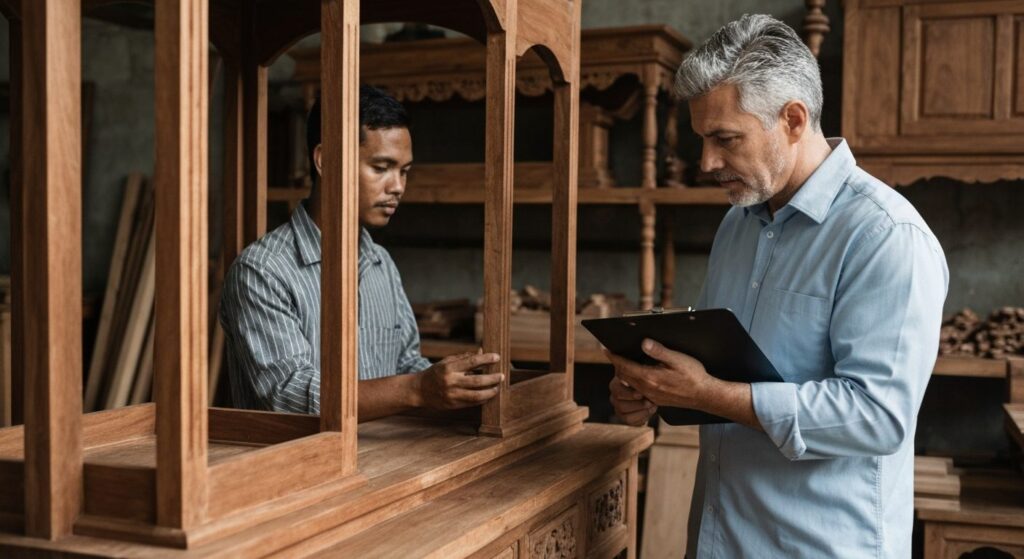
How we work, plainly: Bali Export Broker is the sourcing & export desk of the same Indonesian furniture and home-decor exporter behind baliteakfurniture.com, under Juara Holding Group. We act as your buying agent and earn a disclosed commission or service fee agreed per project — we are not unpaid and not a “free” agent. Furniture, rattan/natural-fiber, recycled teak and home decor we source and export directly; every other category we match via vetted producer partners and say so. SVLK/V-Legal, FSC and similar documents are issued by certified workshops and accredited bodies, not by us. Figures (HS codes, container volumes, lead times) are general references; final scope and pricing are by quote.
A buying agent commission rate is the transparent service fee a procurement professional or agency charges for sourcing products, managing supply chains, and overseeing the export process on behalf of an importer. This commission, typically ranging from 5-10% of the Free On Board (FOB) value, covers their expertise, network, and operational costs, ensuring accountability and efficiency in international trade.
What is a Buying Agent Commission Rate?
The buying agent commission rate represents the compensation structure for a sourcing agent or broker who facilitates the procurement and export of goods. This rate is a fundamental aspect of the B2B procurement landscape, particularly when dealing with international supply chains where local expertise is crucial. It is not an arbitrary charge but a transparent fee for a specialized service that mitigates risks, ensures quality, and streamlines logistics.
When an importer engages a buying agent, they are essentially outsourcing critical aspects of their supply chain management to a specialist. This includes everything from initial supplier identification and vetting to quality control, negotiation, consolidation, and export documentation. The commission rate reflects the value of this comprehensive service, enabling the importer to focus on their core business while the agent handles the complexities of overseas procurement. At Bali Export Broker, we operate as a paid buying agent, earning a transparent commission or service fee for our dedicated end-to-end support. This ensures our alignment with your success and our accountability throughout the sourcing and export journey.
Direct Costs vs. Value-Added Service
It is important to distinguish the buying agent’s commission from the direct costs of the product itself. The product’s cost (e.g., ex-factory price) is what the manufacturer charges for the goods. The buying agent’s commission is an additional layer, representing the cost of their professional service. This service adds significant value by:
- Minimizing risk: Identifying reliable suppliers, preventing scams, and ensuring contractual adherence.
- Ensuring quality: Implementing robust Quality Control (QC) protocols from production start to container loading.
- Optimizing logistics: Consolidating orders, managing freight bookings, and handling complex export documentation.
- Providing market intelligence: Offering insights into pricing, material availability, and regulatory changes in Indonesia.
- Resolving issues: Acting as a local representative to address production delays, quality discrepancies, or shipping challenges promptly.
Without a competent buying agent, importers often face higher risks of production errors, shipping delays, quality inconsistencies, and communication breakdowns, which can ultimately incur far greater costs than any commission fee.
The Role of a Buying Agent in Indonesia
In a market like Indonesia, particularly for sectors such as furniture, rattan, recycled teak, and home decor, a buying agent performs a multifaceted role. The archipelago’s diverse geography, varied production capabilities, and unique cultural nuances necessitate on-the-ground representation. A buying agent in Indonesia, such as the desk at Bali Export Broker, acts as your single point of contact, orchestrating the entire process:
- Brief Intake: Understanding your product specifications, target pricing, and quality standards.
- Supplier Matching: Identifying and vetting workshops in Bali and Jepara that meet your specific requirements. This includes assessing their production capacity, material sourcing, finishing capabilities, and ethical practices.
- Sample Management: Coordinating sample production, revisions, and approval processes to ensure the product meets your exact design and quality expectations. This culminates in the golden-sample sign-off.
- Order Management & Production Monitoring: Overseeing production timelines, communicating with manufacturers, and conducting regular QC checks throughout the manufacturing cycle.
- Quality Assurance: Implementing pre-production, in-line, and final inspection protocols. For furniture and home decor, this might involve verifying wood moisture content, joint integrity, finishing quality, and packaging specifications (e.g., ISTA 3A).
- Container Consolidation: Arranging for goods from multiple workshops to be consolidated into a single container (e.g., 20’DC, 40’HC) to optimize shipping costs.
- Export Documentation: Preparing all necessary paperwork, including commercial invoices, packing lists, Bills of Lading (B/L), Certificates of Origin (COO), and fumigation certificates.
- Incoterms Handoff: Managing the handoff according to agreed Incoterms (e.g., FOB, Ex Works, CIF), ensuring smooth transition of responsibility and costs.
This comprehensive service is precisely what the buying agent commission rate covers, providing importers with peace of mind and operational efficiency.
Typical Buying Agent Commission: The 5-10% Industry Standard
The typical buying agent commission in the Indonesian export market, particularly for goods like furniture, rattan, and home decor, generally falls within a range of 5-10% of the Free On Board (FOB) value of the goods. This range is widely accepted across the industry and reflects the standard cost for professional, accountable sourcing and export management services. While a 5% commission might be applicable for high-volume, straightforward orders with established suppliers, more complex projects, those requiring extensive development, or smaller order values often command a rate closer to 10%.
It’s crucial to understand that this percentage is not arbitrary. It accounts for the agent’s operational overhead, their team’s salaries, travel expenses for factory visits and QC, communication infrastructure, and the inherent risks and responsibilities involved in managing international trade. A reputable buying agent operates on a transparent, commission-based model, ensuring that their interests are aligned with achieving the best outcomes for their clients, not just the lowest price.
Factors Influencing Commission Percentage
Several factors can influence where a specific project’s buying agent commission rate falls within the typical 5-10% range:
- Order Volume and Value: Larger, higher-value orders often attract a lower percentage commission because the agent’s absolute earnings are higher, making a smaller percentage viable. Conversely, smaller orders may necessitate a higher percentage to cover the fixed costs of management and oversight.
- Product Complexity: Sourcing highly customized items, products requiring extensive R&D, intricate quality control, or specialized materials (e.g., specific FSC-certified timber, unique natural fibers) can lead to a higher commission. Simple, off-the-shelf products may command a lower rate.
- Supplier Base: If the sourcing involves identifying entirely new suppliers, extensive vetting, or managing a multitude of small workshops, the labor intensity increases, potentially affecting the commission. Projects with established, well-documented suppliers might incur a lower rate.
- Service Scope: A basic sourcing service might be at the lower end of the scale. A comprehensive, end-to-end service including design development, multiple rounds of sampling, stringent QC at every stage, and complex logistics will naturally command a higher rate.
- Lead Time and Urgency: Rush orders or projects with exceptionally tight deadlines often require more intensive management and quicker responses, which can influence the commission rate. Standard lead times for custom furniture, for example, can range from 8-14 weeks, but expedited services will carry additional costs.
- Market Volatility: In periods of high material price fluctuations or supply chain disruptions, the agent’s role in negotiation and risk mitigation becomes more critical, sometimes reflected in the commission.
At Bali Export Broker, we never state a fixed percentage as our universal rate. Instead, we provide a transparent quote tailored to the specific requirements and complexities of each buyer’s brief, ensuring clarity from the outset.
How Sourcing Commission Works with Different Product Categories
The structure and application of the sourcing agent commission percentage can vary slightly depending on the product category and how Bali Export Broker engages with the supply chain. We maintain absolute transparency regarding our role in every transaction.
-
Directly Sourced & Exported Categories: For our core categories—furniture, rattan/natural-fiber products, recycled teak items, and general home decor—we manage the sourcing and export desk end-to-end. This means we take your brief, match it to our vetted workshops in Bali and Jepara, oversee production, conduct QC, consolidate containers, and handle all export documentation and freight arrangements. For these categories, our commission is a direct service fee from you, the importer, covering our comprehensive expertise and operational costs. We are the single point of contact and the direct export hub under Juara Holding Group.
-
Partner-Matched Categories: For categories outside of our direct export specialization, such as textiles, specific handicrafts, or certain food products, we operate by commission-matching you with vetted producer partners. In these instances, we still act as your initial point of contact, helping to define your brief and connect you with a suitable and reliable partner from our network. Our role shifts to facilitating the introduction and ensuring a clear handover. In cases where you proceed with one of our vetted partners, they may pay us a referral fee. This referral fee is structured such that it comes at no extra cost to you, the buyer. Our commitment to transparency means that the final pricing you receive from the partner will not be inflated by our referral arrangement. Our primary value remains in connecting you with trustworthy suppliers and providing that initial layer of accountability.
This dual approach ensures that whether we are directly managing the export or connecting you with a specialized partner, you benefit from our rigorous vetting process and our commitment to transparency in commission structures.
Commission Models: Beyond the Percentage
While the percentage-based commission is the most prevalent model for buying agents, particularly in the sourcing and export sector, other structures exist. Understanding these variations helps importers evaluate which model best suits their project’s scope, budget, and risk profile. At Bali Export Broker, our primary model is percentage-based due to the dynamic nature of sourcing and the comprehensive, ongoing management required. However, we believe in educating our clients about the landscape of commission structures.
| Model | Description | Pros for Importer | Cons for Importer | Typical Use Case |
|---|---|---|---|---|
| Percentage-Based | Agent earns a percentage (e.g., 5-10%) of the FOB value of goods. | Cost scales with order value; agent motivated for better product pricing. | Less predictable for very small orders; can be higher for complex, low-volume items. | Standard for ongoing sourcing, repeat orders, large volumes (e.g., furniture, home decor). |
| Flat Fee | A fixed amount charged per project, order, or service (e.g., per QC inspection, per factory audit). | Predictable cost; clear budget for specific tasks. | May not cover extensive unforeseen issues; less incentive for agent to optimize price if scope is fixed. | One-off tasks, initial factory audits, specific QC checks, small sample orders. |
| Retainer / Project-Based | An upfront fee for a defined period or project, often with hourly rates for additional work. | Secures agent’s dedicated time; good for complex R&D or long-term development. | Can be expensive if project scope changes; requires careful scope definition. | Product development, new brand launches, complex multi-stage projects. |
| Hybrid Model | Combines elements, e.g., a small retainer plus a reduced percentage commission. | Balances predictability with incentive; flexible for varying project needs. | Can be more complex to track and manage initially. | Long-term partnerships with evolving sourcing requirements. |
Percentage-Based Commission (Most Common)
The percentage-based model remains the industry standard for comprehensive sourcing and export services. This model aligns the agent’s financial success directly with the volume and value of the orders they manage. For instance, if an importer orders furniture valued at USD 50,000 FOB, and the agreed commission is 8%, the agent earns USD 4,000. This structure is particularly effective for ongoing relationships and repeat orders, as it provides a predictable income stream for the agent and a scalable cost for the importer. It also motivates the agent to ensure competitive pricing from suppliers, as a lower product cost directly impacts the importer’s total landed cost, fostering a stronger, long-term partnership.
Flat Fee Structure
A flat fee model involves a fixed payment for a specific service, regardless of the order value. This is often used for discrete tasks such rather than full-cycle sourcing. For example, an agent might charge a flat fee of USD 300-500 (last verified June 2026) for a single, comprehensive factory audit or a pre-shipment inspection report for a specific CBM volume. While offering cost predictability for defined services, this model is less common for end-to-end sourcing because the effort involved can vary significantly with product complexity and supplier performance. It offers less incentive for the agent to proactively manage ongoing issues or optimize costs beyond the initial scope.
Retainer or Project-Based Fees
Retainers are typically paid upfront for a defined period or for a specific project with a complex scope, such as extensive product development, market research, or establishing a new supply chain from scratch. This model guarantees the agent’s dedicated time and resources for intricate tasks that may not immediately result in a large product order. For instance, a retainer of USD 1,500-3,000 per month (last verified June 2026) might be charged for 3-6 months to develop a new line of recycled teak outdoor furniture, including prototyping, material testing, and identifying specialized finishing techniques. This model ensures the agent is compensated for the significant preliminary work required before production begins.
Cost-Savings-Based Fees (Less Common for Sourcing)
In this model, the agent’s fee is a percentage of the savings they achieve for the importer compared to a benchmark price. While popular in some procurement consulting contexts, it is less common for full-service sourcing agents who manage the entire export process. The challenge lies in objectively establishing a credible benchmark price. For instance, an agent might claim to save 10% on a product, and their fee could be 30% of that 10% saving. This model can create strong incentives for the agent to negotiate aggressively, but it also introduces complexity in verifying the baseline cost and can be difficult to apply consistently across diverse product categories like custom furniture. It typically functions better in highly commoditized markets rather than custom-made artisan goods.
Transparency in Buying Agent Commission
Transparency is not merely a buzzword; it is a fundamental pillar of trust in international trade relationships. At Bali Export Broker, we consider clear and honest disclosure of our buying agent commission to be non-negotiable. Importers need to understand precisely what they are paying for and how their agent is compensated to avoid hidden costs, conflicts of interest, and eroded trust. Without transparency, the true cost of goods can become obscured, making accurate landed cost calculations impossible and undermining the importer’s ability to plan effectively.
Why Transparency Matters
For importers, understanding the commission structure enables:
- Accurate Costing: Knowing the exact commission allows for precise calculation of total landed costs, which is critical for pricing products competitively in the destination market.
- Budget Management: Transparent fees help importers budget effectively for their sourcing projects, avoiding unexpected expenses.
- Trust and Confidence: A clear commission structure builds confidence in the agent’s integrity and commitment to fair dealings. It demonstrates that the agent is not operating with hidden agendas or undisclosed markups.
- Performance Evaluation: When the commission is transparent, importers can better assess the value an agent provides relative to their fees, evaluating efficiency, quality, and problem-solving capabilities.
- Reduced Risk: Opaque commission structures can be a red flag, often associated with agents who may prioritize their own margins over the client’s best interests, potentially leading to inflated product prices or substandard quality.
Our Approach at Bali Export Broker
At Bali Export Broker, our approach to buying agent commission is rooted in complete transparency. We provide a detailed breakdown of our service fees during the initial consultation phase, tailored to your specific sourcing brief.
- Clear Quote: We will present a clear, itemized quote for our services, specifying the commission percentage or fee structure applicable to your project. This quote will clearly outline what services are included.
- No Hidden Fees: We do not believe in hidden markups on product prices or undisclosed “referral fees” that inflate your costs. Our compensation comes directly from our stated commission or service fee, ensuring that the prices we negotiate with our vetted Bali and Jepara workshops are the best available for the specified quality.
- Honest Split (Own-Export vs. Partner-Matched): We are upfront about our operational model. For furniture, rattan/natural-fiber, recycled teak, and home decor, we act as your direct export desk. For other categories, we match you with vetted producer partners. In both scenarios, our commission covers our active role in matching, managing, and ensuring accountability. If you proceed with a partner for a category we don’t directly export, that partner may pay us a referral fee, but importantly, this fee comes at no extra cost to you, the importer. Our commitment is to finding the right fit for your needs without compromising your cost structure.
- Accountability: Our commission is earned through active management, rigorous quality control, and proactive problem-solving. This means we are accountable for every step, from the golden-sample sign-off to the Incoterms handoff, ensuring your interests are protected throughout the entire sourcing and export process.
This commitment to clarity ensures that you always know the cost of our expertise and can confidently integrate it into your overall procurement strategy.
The Value Proposition: Why Pay a Commission?
Engaging a professional buying agent and paying a commission is an investment that yields significant returns, often far outweighing the cost of the fee itself. The value proposition lies in transferring the complexities, risks, and time-consuming tasks of international sourcing to an expert. For importers looking to source specific items like furniture, rattan, recycled teak, or home decor from Indonesia, an agent like Bali Export Broker transforms potential challenges into streamlined processes.
Risk Mitigation and Quality Control
The primary value of a buying agent is often in mitigating the substantial risks inherent in international procurement. Without local representation, importers face:
- Supplier Fraud: Risk of dealing with unscrupulous suppliers who deliver substandard goods or fail to deliver at all.
- Quality Discrepancies: Products not meeting specifications, material substitutions, or poor craftsmanship. Our team conducts regular QC checks on the ground, verifying dimensions, materials (e.g., specific wood types, rattan weave patterns), construction, and finish adherence to the golden sample.
- Production Delays: Factories missing deadlines due to poor planning, material shortages, or labor issues. We monitor production closely and intervene proactively.
- Communication Barriers: Misunderstandings due to language differences or cultural nuances leading to costly errors. We provide clear, direct communication.
- Compliance Issues: Incorrect documentation, non-compliance with import regulations, or environmental standards. We ensure all export documentation (e.g., fumigation certificates, Certificates of Origin) is accurate and complete.
Our rigorous QC process, spanning pre-production, in-line, and final inspections, significantly reduces these risks. For instance, for a container of Jepara furniture, we might verify wood moisture content is below 12%, inspect all joints for stability, check color consistency across batches, and supervise packaging to prevent transit damage for a CBM ranging between 25-60 cubic meters depending on container size.
Expert Supplier Matching (Bali & Jepara Focus)
Indonesia’s manufacturing landscape is vast and fragmented. Identifying the right workshop that can consistently produce to your quality standards, volume requirements, and ethical expectations is a specialized skill.
- Vetted Network: Bali Export Broker maintains a thoroughly vetted network of workshops in Bali and Jepara specializing in furniture, rattan, recycled teak, and home decor. This network has been built over years, ensuring reliability, consistent quality, and fair labor practices.
- Capacity and Capability Assessment: We assess workshops not just on price, but on their actual capacity, machinery (e.g., kiln-drying facilities, CNC capabilities), material sourcing practices, and finishing expertise. A workshop in Jepara might excel at carved teak furniture, while a Bali workshop might specialize in contemporary rattan designs.
- Negotiation Leverage: Our local presence and established relationships provide leverage in negotiating competitive pricing and favorable terms, ensuring your costs are optimized without compromising quality.
This expertise in matching your brief to the ideal producer saves immense time and prevents costly trial-and-error.
Streamlined Export Logistics and Documentation
complexities of international shipping and customs is a critical aspect of the export process.
- Consolidation Expertise: We expertly consolidate goods from multiple workshops into single containers (e.g., a mix of Bali decor and Jepara furniture in a 40’HC container), maximizing container space and reducing per-item shipping costs. This can reduce freight costs by 15-30% compared to multiple LCL shipments, depending on volume and destination (last verified June 2026).
- Incoterms Management: We manage the entire process from Ex Works (EXW) through to Free On Board (FOB) or Cost, Insurance, and Freight (CIF), coordinating with freight forwarders, ensuring timely bookings, and handling all port logistics.
- Accurate Documentation: Producing correct export documentation is paramount to avoid customs delays and penalties. We prepare all necessary paperwork, including commercial invoices, packing lists, Bills of Lading (B/L), Certificates of Origin (COO), and specific permits (e.g., Phytosanitary certificates for wood, CITES for certain materials if applicable), ensuring compliance with international and destination country regulations. A single error in an HS code (e.g., 9403.60 for wooden furniture) can cause significant delays.
Time and Cost Efficiency
Ultimately, the buying agent’s commission represents an investment in efficiency.
- Reduced Overhead: Importers avoid the significant overhead of establishing and maintaining their own sourcing office in Indonesia, including staff salaries, office rent, and travel expenses.
- Faster Time-to-Market: Our established processes and network expedite the sourcing cycle, from brief to delivery, allowing you to bring products to market faster.
- Cost Savings: While there is a commission, the overall cost savings achieved through better supplier pricing, reduced quality issues, optimized logistics, and avoidance of costly mistakes often translate to a lower total landed cost than if an importer attempted to manage everything independently.
By paying a transparent commission, importers gain a dedicated, expert partner on the ground, ensuring their sourcing goals are met with professionalism and precision.
Navigating Sourcing Agent Commission Percentage for Your Project
Understanding how to approach and negotiate the sourcing agent commission percentage is key to a successful partnership. It’s not about driving the fee down to an unsustainable level, but about ensuring the commission aligns with the value provided and the complexity of
Ready to source from Indonesia?
Get a no-obligation sourcing quote from our export desk — we scope your project, match vetted workshops, and quote the disclosed commission/service fee per order. Request a quote or message us on WhatsApp.