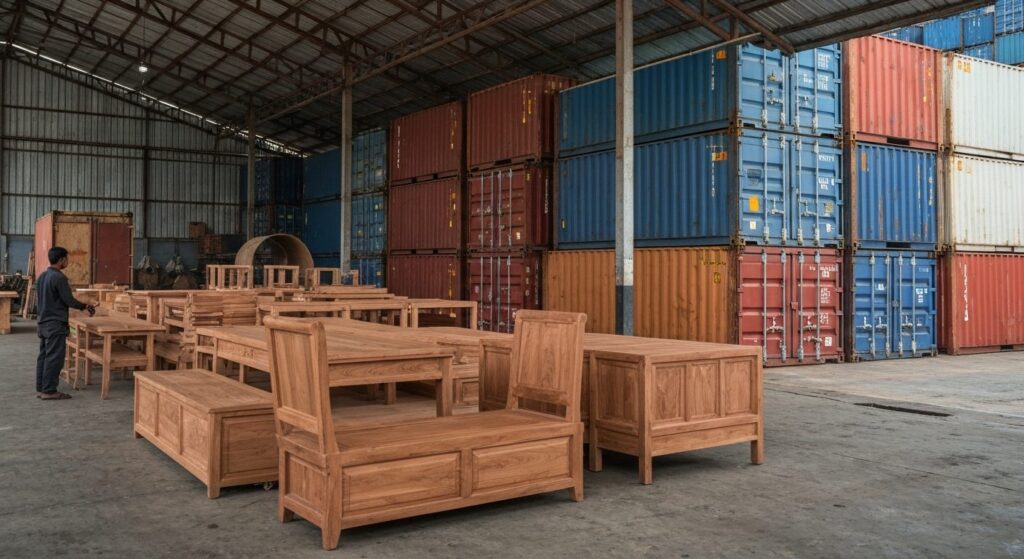
When ordering from Indonesia, deposit terms typically follow a 30% upfront payment, with the remaining 70% due before shipment. Some suppliers, particularly for custom or high-value orders, may request a 50/50 deposit in Indonesia. These terms are foundational to international procurement, establishing a commitment from both buyer and manufacturer.
This guide from the Export & Sourcing desk at Bali Export Broker clarifies the standard payment terms for Indonesian furniture and home decor, detailing the mechanics of Telegraphic Transfer (T/T) and Letter of Credit (L/C), mitigating deposit risks, and outlining how a dedicated buying agent navigates these financial landscapes to secure your investment.
Understanding Standard Deposit Terms in Indonesia
The majority of Indonesian manufacturers operate on a deposit system to cover initial material costs and secure production slots. This practice is standard across the industry, from small workshops producing intricate rattan pieces to larger facilities manufacturing solid teak furniture.
The 30/70 Payment Structure
The 30/70 split is the most prevalent deposit term ordering from Indonesia. Under this arrangement:
• 30% Deposit: An initial 30% of the total order value is paid upfront. This payment confirms the order, allows the workshop to purchase raw materials (such as specific timber, rattan cane, or recycled teak components), and allocates production capacity. It also signifies the buyer’s commitment to the order.
• 70% Balance Payment: The remaining 70% of the order value is due upon completion of production, typically before the goods are loaded into the shipping container or released from the factory floor. Payment is often triggered by photographic evidence of finished goods, a pre-shipment quality control (QC) inspection report, and confirmation of export documentation readiness.
This structure provides a balance of risk between buyer and supplier. The supplier receives capital to initiate production, while the buyer retains a significant portion of the payment until the goods are ready for dispatch, offering a degree of leverage and security.
The 50/50 Deposit in Indonesia
While less common for standard orders, a 50/50 deposit in Indonesia may be requested in specific scenarios:
• Highly Customised Orders: Projects requiring significant design development, unique tooling, or very specific, high-cost raw materials not typically stocked by the workshop may warrant a larger upfront investment.
• New Supplier Relationships: For initial orders with a new supplier, a 50/50 deposit can be a way for the manufacturer to mitigate risk, especially if the order value is substantial or if the buyer’s credit history is unknown.
• High-Value Materials: Orders involving rare woods, intricate carvings, or other high-cost components might necessitate a larger deposit to cover these specific material procurements.
• Small Workshops/Artisans: Smaller, independent artisans or workshops with limited working capital might request a 50/50 split to ensure they can cover all production costs without financial strain.
A 50/50 deposit structure shifts more of the initial financial commitment to the buyer. While it can accelerate production by ensuring immediate access to funds for all material purchases, it also concentrates more risk upfront. It is crucial to have robust oversight and verification processes in place when agreeing to such terms.
Payment Methods for Indonesia Furniture Payment Terms
The choice of payment method significantly impacts transaction security, cost, and speed. The two primary methods for international payments when dealing with Indonesia furniture payment terms are Telegraphic Transfer (T/T) and Letter of Credit (L/C).
Telegraphic Transfer (T/T)
A Telegraphic Transfer, also known as a wire transfer, is the most common method for sending funds internationally.
• Mechanism: Funds are transferred directly from the buyer’s bank account to the supplier’s bank account via SWIFT (Society for Worldwide Interbank Financial Telecommunication) network.
• Pros:
* Cost-Effective: Generally, T/T fees are lower than L/C fees, making it a more economical option for both parties.
* Faster: Transfers typically complete within 2-5 business days, allowing for quicker initiation of production.
* Simpler Process: Less documentation and procedural complexity compared to L/C.
• Cons:
* Lower Security for Buyer: Payment is made directly to the supplier with fewer intermediary checks. Once the funds are sent, they are difficult to recall. This method relies heavily on trust between the buyer and supplier.
* Risk of Non-Delivery/Quality Issues: Without an L/C, the buyer has less recourse if the supplier fails to deliver, delivers substandard goods, or disappears with the deposit.
• When to Use: T/T is suitable when a high level of trust exists between the buyer and supplier, or when a reputable buying agent like Bali Export Broker is managing the transaction on the ground, providing an additional layer of security and oversight.
Letter of Credit (L/C)
A Letter of Credit is a financial instrument issued by a bank that guarantees payment to the seller (supplier) upon the presentation of specific, conforming documents.
• Mechanism: The buyer’s bank (issuing bank) guarantees payment to the seller’s bank (advising bank) once the seller has met all stipulated conditions, typically involving shipping documents (Bill of Lading, Commercial Invoice, Packing List, Certificate of Origin, QC report).
• Pros:
* Higher Security for Buyer: The bank acts as an impartial intermediary, ensuring that the supplier only gets paid if they meet all agreed-upon conditions and submit the correct documentation. This significantly reduces the risk of non-delivery or non-conforming goods.
* Mitigates Production Risk: The supplier has assurance of payment if they fulfill their obligations, which can be beneficial for larger, complex orders.
• Cons:
* Higher Costs: L/C fees are considerably higher than T/T fees, borne by either the buyer or split, making it more expensive. Fees can range from 0.5% to 3% of the L/C value, varying by bank and complexity (last verified June 2026).
* Complexity and Time-Consuming: The L/C process involves extensive documentation, strict timelines, and precise adherence to terms. Any discrepancies can lead to delays and additional costs.
* Less Flexible: Amendments to an L/C are difficult and costly, requiring agreement from all parties.
• When to Use: L/C is generally recommended for very large orders, with new suppliers where trust is still being built, or when dealing with high-risk markets where additional financial security is paramount. For many standard furniture orders from established suppliers, the complexity and cost of an L/C may outweigh its benefits, especially when an agent is involved.
Comparison of T/T vs. L/C
| Feature | Telegraphic Transfer (T/T) | Letter of Credit (L/C) |
|---|---|---|
| Security for Buyer | Low (relies on trust) | High (bank guarantees payment upon document compliance) |
| Security for Supplier | Medium (deposit received, balance before shipment) | High (bank guarantees payment if terms met) |
| Cost | Low (bank transfer fees only) | High (bank fees, processing charges, potential discrepancy fees) |
| Speed | Fast (2-5 business days) | Slow (requires extensive documentation processing and bank approvals) |
| Complexity | Low (simple bank-to-bank transfer) | High (strict adherence to documentation, terms, and conditions) |
| Flexibility | High (easier to adjust terms informally) | Low (amendments are complex and costly) |
| Ideal Use | Trusted suppliers, smaller orders, with agent oversight | New suppliers, large orders, high-risk transactions |
Why Deposits Are Standard in Indonesian Manufacturing
The requirement for an upfront deposit is not a unique practice to Indonesia; it is a global standard in manufacturing. For Indonesian workshops, it serves several critical purposes:
Raw Material Procurement
Many raw materials, especially timber (like recycled teak, mahogany, mindi wood), rattan, natural fibers (seagrass, water hyacinth), and metal components, require upfront payment to suppliers. The deposit ensures the workshop has the necessary capital to purchase these materials without incurring debt or tying up their own working capital. Given fluctuating material costs, securing these purchases early is essential for price stability.
Labor and Overhead Costs
Manufacturing involves significant labor costs, from skilled artisans to production line workers. Deposits help cover initial wages, workshop overheads, utility bills, and other operational expenses during the early stages of production, before the final payment is received.
Commitment and Risk Mitigation for Suppliers
A deposit is a tangible commitment from the buyer. It signals seriousness and reduces the risk for the manufacturer of a canceled order after materials have been purchased and production has begun. Without a deposit, workshops would face substantial financial exposure if orders were to fall through.
Customisation and Special Orders
Indonesian furniture and decor are highly sought after for their customisation potential. Whether it’s a specific finish, unique dimensions, or entirely new designs, these bespoke elements often involve materials that are not part of a workshop’s standard stock. A deposit ensures that the specific materials and labor for these custom requirements are funded from the outset.
Navigating Deposit Risk: The Pitfalls Without an Agent
The international procurement landscape, while rewarding, carries inherent risks, particularly when dealing with deposits. Without an experienced, on-the-ground agent, importers face several potential pitfalls:
Non-Existent or “Ghost” Suppliers
One of the most significant risks is encountering a fraudulent entity. A “supplier” may present professional-looking websites or catalogs, communicate effectively, and even provide seemingly legitimate proforma invoices. However, after receiving a deposit, they might disappear, cease communication, or simply never initiate production. Recovering funds from a non-existent entity in a foreign country is exceptionally difficult, if not impossible.
Substandard Quality and Specifications Deviations
Even with a legitimate supplier, the quality of goods produced may not meet the agreed-upon standards. Without consistent oversight, a manufacturer might cut corners on materials, finishes, or construction methods. Deviations from specifications, incorrect dimensions, or poor craftsmanship can render an entire order unsellable, leading to significant financial losses and reputational damage.
Production Delays and Missed Deadlines
Suppliers may overcommit, face unexpected material shortages, or have internal production issues. Without an agent to monitor progress, enforce timelines, and proactively address bottlenecks, production delays can become chronic. Missed deadlines can disrupt supply chains, incur storage fees, and result in lost sales opportunities for the importer.
Communication Barriers and Misunderstandings
Language differences, cultural nuances, and time zone discrepancies can lead to misunderstandings regarding specifications, quality expectations, and delivery schedules. These communication breakdowns can result in costly errors and strained relationships.
Loss of Deposit Without Recourse
In scenarios of fraud, severe quality issues, or outright non-delivery, the deposit paid by the buyer is often lost. Without a local legal entity or a representative to pursue legal action or mediate disputes, importers typically have limited recourse, especially across international borders. The cost and complexity of international litigation often outweigh the value of the lost deposit.
How Bali Export Broker Mitigates Deposit Risk
As your dedicated buying agent and export broker in Indonesia, Bali Export Broker’s primary role is to act as your eyes and ears on the ground, significantly mitigating the risks associated with deposit terms ordering from Indonesia. My team and I provide a structured approach to safeguard your investment.
Vetted Supplier Network
We maintain a rigorously vetted network of workshops in Bali and Jepara. This network is built on years of direct experience, site visits, and performance evaluations. We do not work with unverified entities. Our direct export categories—furniture, rattan/natural-fiber, recycled teak, and home decor—are sourced directly from these proven workshops. For other categories, we commission-match you with equally vetted producer partners, stating this plainly. We never claim a factory, certification, award, or commission percentage we cannot prove. This initial vetting drastically reduces the risk of fraudulent suppliers.
Transparent Contracting and Payment Management
When you work with Bali Export Broker for our direct export services, your contract is with us. We handle the direct payment to the workshops on your behalf, after ensuring all terms are understood and agreed upon. This means your deposit is held and managed by an accountable, legally established Indonesian entity – Bali Export Broker – rather than being sent directly to an unknown workshop. This provides a crucial layer of financial security.
Continuous Quality Control (QC)
Our team conducts multiple stages of quality control throughout the production process:
• Initial Material Check: Verifying the quality and quantity of raw materials upon arrival at the workshop.
• In-Process Inspections: Monitoring craftsmanship, construction, and adherence to specifications at various stages of production.
• Pre-Shipment Inspection (PSI): A comprehensive inspection of finished goods, ensuring they meet all agreed-upon standards, dimensions, finishes, and packaging requirements before the final 70% balance is released. We provide detailed reports with photographic evidence.
This continuous oversight ensures that your products are being manufactured correctly, reducing the risk of receiving substandard goods and thus protecting your deposit.
Proactive Communication and Problem Solving
We serve as your single point of contact, managing all communications with the workshops. This eliminates language barriers and cultural misunderstandings. Should any issues arise during production, we are on-site to address them immediately, negotiate solutions, and ensure your interests are protected, preventing minor issues from escalating into significant problems.
Accountability and Legal Framework
As a registered Indonesian company under Juara Holding Group, Bali Export Broker operates within the local legal framework. This provides a clear avenue for accountability and recourse should any disputes arise. We manage the entire export documentation process, ensuring compliance with Indonesian regulations and international shipping standards.
Transparent Service Fee Model
As a dedicated buying agent, Bali Export Broker operates on a transparent service fee or commission, openly discussed and agreed upon with our clients. This fee covers our extensive vetting processes, continuous quality control, logistical coordination, export documentation, and the security of knowing your deposit is managed by an accountable entity on the ground. We provide an invaluable layer of expertise, oversight, and risk mitigation that directly protects your investment and streamlines your import process. We are a paid service, and our value lies in the accountability and expertise we bring to every step of your procurement journey.
Factors Influencing Indonesia Furniture Payment Terms
While 30/70 is standard, and 50/50 is seen, several factors can influence the exact payment terms offered by Indonesian suppliers. Understanding these can help in negotiations.
Product Category and Complexity
- High-End or Custom Furniture: Items requiring intricate carvings, bespoke designs, or expensive, rare materials (e.g., specific types of recycled teak, or specialized hardware) may demand a larger deposit (e.g., 50/50) due to higher initial material investment and specialized labor.
- Standard Home Decor: Mass-produced, lower-value items, or those made from readily available materials, might more consistently adhere to the 30/70 split.
Supplier Size and Capitalization
- Small Workshops/Artisans: Smaller entities with limited working capital may require a higher deposit to cover material costs and sustain operations during the production cycle. They might not have the financial reserves to float significant material purchases.
- Large Factories: Larger, well-established factories with substantial capital might be more flexible with deposit terms, especially for repeat clients or large orders, sometimes accepting terms slightly more favorable than 30/70, though this is rare.
Buyer-Supplier Relationship and History
- New Clients: First-time buyers are almost always subject to standard deposit terms (30/70 or 50/50) as trust is yet to be established.
- Long-Term Clients: Buyers with a proven track record of consistent orders and timely payments may negotiate slightly more favorable terms over time, such as a smaller initial deposit for subsequent orders, though this is not guaranteed.
Order Value and Quantity
- Small Orders: For very small orders (e.g., less than a full container load, or FCL), suppliers might request a higher percentage deposit to compensate for the relatively higher administrative and fixed costs per unit.
- Large Orders: While large orders involve significant capital, if the supplier is confident in the buyer’s commitment, they might stick to the 30/70, as the sheer volume provides sufficient initial capital.
Lead Times
Longer lead times for complex products, such as custom-built furniture that can take 10-12 weeks for production (excluding shipping), generally necessitate a standard deposit to cover the extended period of material holding and labor allocation. Shorter lead times for in-stock or fast-moving items might occasionally see slight variations, but this is less common.
Negotiating Deposit Terms: Practical Considerations
While standard deposit terms are prevalent, there can be limited scope for negotiation, especially when working with a trusted agent.
When Negotiation Might Be Possible
- Existing Relationships: If you have a long-standing, positive relationship with a particular workshop, they might be open to minor adjustments on future orders.
- Very Large Orders: For exceptionally large orders that provide significant business to a factory, there might be a slim chance to discuss a slightly lower initial deposit, provided the overall order value remains substantial.
- Strategic Importance: If your order is strategically important to the supplier (e.g., a new product line they want to develop, or access to a new market segment), they might be more flexible.
What to Consider Before Negotiating
- Supplier’s Financial Health: Pushing for excessively low deposits can strain a small workshop’s finances, potentially impacting production quality or timelines. A stable supplier is in your best interest.
- Market Standards: Be aware that most Indonesian suppliers operate on similar terms. Aggressive negotiation might signal an unreliable buyer or lead to the supplier prioritizing other clients.
- Value of an Agent: When working with Bali Export Broker, our transparent service fee is a cost for security and efficiency. Attempting to reduce deposit terms to an unsustainable level can undermine the very system designed to protect your interests and ensure production. We focus on securing fair, standard terms that ensure production quality and timely delivery, rather than pushing for unsustainable payment structures.
Ultimately, a fair deposit structure benefits both parties. It provides the supplier with the necessary capital to produce high-quality goods, and it secures the buyer’s commitment while retaining a significant portion of the payment until product readiness.
If you’re ready to discuss your sourcing needs and navigate the complexities of deposit terms with accountability and expertise, reach out to us. We can help you plan your next import from Indonesia. Contact us today to plan your import, or connect via WhatsApp for direct assistance.
Frequently Asked Questions About Deposit Terms in Indonesia
What is the typical deposit for furniture orders from Indonesia?
The typical deposit for furniture orders from Indonesia is 30% of the total order value, paid upfront, with the remaining 70% due before shipment. For custom, high-value, or initial orders with new suppliers, a 50/50 deposit may be requested.
Why do Indonesian suppliers require a deposit?
Indonesian suppliers require a deposit primarily to cover the upfront costs of raw materials, allocate production capacity, and secure the buyer’s commitment to the order. This helps mitigate the supplier’s financial risk and ensures smooth production flow.
Is it safe to pay a deposit to an Indonesian supplier via T/T?
Paying a deposit via Telegraphic Transfer (T/T) can be safe if you are dealing with a trusted, verified supplier or, more securely, through a reputable buying agent like Bali Export Broker. Sending funds directly to an unverified supplier carries significant risk, as T/T payments are difficult to recall once sent. An agent provides an essential layer of vetting and oversight.
When should I consider using a Letter of Credit (L/C) for my Indonesian import?
A Letter of Credit (L/C) should be considered for very large orders, when dealing with a new supplier with whom you have no established trust, or for high-risk transactions where the added security outweighs the higher costs and complexity. For many standard orders, especially with an agent, T/T is more common due to its lower cost and faster processing.
How does Bali Export Broker protect my deposit?
Bali Export Broker protects your deposit by acting as your accountable local partner. We vet all workshops, manage the payment process by contracting with you and then directly with the workshops, conduct continuous quality control checks, and provide transparent communication. This ensures your funds are managed by a reliable entity and are only disbursed as production milestones are met and quality standards are confirmed.
financial aspects of international sourcing, especially deposit terms ordering from Indonesia, requires diligence and local expertise. At Bali Export Broker, my team and I are here to provide that expertise, ensuring your investments are secure and your procurement process is efficient. Let’s start a conversation about your next project. Plan your import with us or reach out on WhatsApp to discuss your specific requirements.