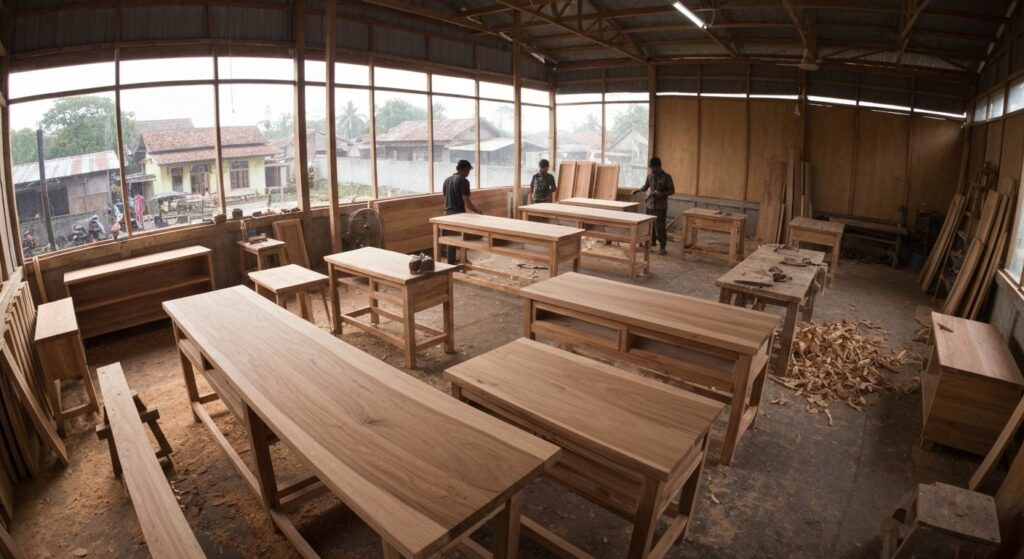
How we work, plainly: Bali Export Broker is the sourcing & export desk of the same Indonesian furniture and home-decor exporter behind baliteakfurniture.com, under Juara Holding Group. We act as your buying agent and earn a disclosed commission or service fee agreed per project — we are not unpaid and not a “free” agent. Furniture, rattan/natural-fiber, recycled teak and home decor we source and export directly; every other category we match via vetted producer partners and say so. SVLK/V-Legal, FSC and similar documents are issued by certified workshops and accredited bodies, not by us. Figures (HS codes, container volumes, lead times) are general references; final scope and pricing are by quote.
The moq indonesia furniture typically begins at one 20-foot Full Container Load (FCL) from a single workshop. For smaller handicraft items that are less bulky, a minimum order quantity can be as low as US$500 per supplier, though this varies significantly by product and workshop. As the Logistics & Freight desk at Bali Export Broker, our role is to navigate these requirements, transforming a collection of diverse goods from various workshops into a single, clean, and fully documented container ready for international shipment.
What is Minimum Order Quantity (MOQ) in Indonesian Exports?
Minimum Order Quantity (MOQ) represents the fewest units of a product a supplier is willing to produce or sell in a single order. For international trade, especially for bulkier items like furniture, this concept is primarily driven by manufacturing efficiency, material procurement, and the economics of export logistics. Workshops in Indonesia, particularly those specializing in furniture, rattan, recycled teak, and home decor – categories we at Bali Export Broker directly source and export – establish MOQs to ensure their production runs are cost-effective.
Why Factories Set MOQs
Factories set MOQs for several key reasons:
- Production Efficiency: Setting up machinery, preparing materials, and training staff for a specific product run incurs fixed costs. A minimum quantity ensures these overheads are spread across enough units to make the production profitable.
- Material Sourcing: Suppliers often purchase raw materials in bulk to secure better prices. An MOQ helps them align production with their material procurement strategies, avoiding waste and excess inventory.
- Customization and Specialization: Many Indonesian furniture workshops offer bespoke designs or use specialized techniques. MOQs compensate for the time and resources invested in custom tooling or unique processes.
- Logistical Simplification: For larger items like furniture, filling a container from a single order simplifies packing, loading, and documentation processes for the factory.
Understanding these drivers is crucial for buyers. While an MOQ might seem like a barrier, it reflects the operational realities of the highly skilled workshops we partner with.
The Standard: One Container MOQ for Furniture
For furniture items, the prevailing standard for moq indonesia furniture is one 20-foot Full Container Load (FCL). This means that a single workshop typically requires an order large enough to fill, or at least substantially fill, a 20ft container if you are ordering exclusively from them.
What a 20ft FCL Entails
A 20ft FCL container, with an approximate internal volume of 33 cubic meters (CBM), represents a significant volume of goods. For furniture, this could mean:
- Approximately 25-30 dining table sets (table + 4-6 chairs).
- Around 50-70 sofas or armchairs, depending on size.
- A mix of bedroom furniture for several rooms (beds, nightstands, dressers).
These are general estimations, as the actual quantity depends heavily on the specific dimensions and packing efficiency of each item. The key takeaway is that an individual workshop prefers to produce and load an order that justifies dedicating a full container. This preference stems from simplified logistics, reduced handling, and a clear chain of responsibility from their factory floor directly to the vessel.
When a 40ft or 40HC FCL Becomes the MOQ
While 20ft is common, some larger workshops or specialized manufacturers dealing with very bulky items might informally treat a 40ft FCL or even a 40ft High Cube (40HC) FCL as their effective minimum order quantity indonesia furniture. This is particularly true for items like large outdoor furniture sets, oversized cabinets, or very long pieces of timber furniture that require more space.
Minimum Order Quantity Indonesia Furniture: Beyond Full Containers
While a full container is the standard MOQ for furniture from a single workshop, not all buyers need such a large volume. This is where strategic sourcing and logistics, central to Bali Export Broker’s service, become invaluable. We enable clients to effectively reduce their small moq furniture indonesia challenges through consolidation.
Introducing Less than Container Load (LCL) Shipping
LCL shipping allows multiple buyers to share space within a single container. Instead of one client filling an entire 20ft or 40ft FCL, several clients’ goods are consolidated into one container, each paying only for the volume (CBM) their goods occupy.
Pros and Cons of LCL Shipping
- Pros:
- Lower Effective MOQ: You can purchase smaller quantities from multiple workshops, as you are not required to fill an entire container from a single source.
- Flexibility: Ideal for smaller businesses, startups, or those testing new product lines without committing to large inventory investments.
- Diversification: Allows buyers to source a wider variety of products from different suppliers, creating a more diverse inventory.
- Cons:
- Higher Per-CBM Cost: LCL freight rates are generally higher per cubic meter compared to FCL, due to increased handling, consolidation, and deconsolidation fees.
- Longer Transit Times: LCL shipments often require more time for consolidation at the origin port and deconsolidation at the destination port, potentially extending overall transit times.
- Increased Handling: More handling points mean a slightly higher risk of damage, though proper crating and supervision mitigate this significantly.
- Customs Clearance Complexity: While we manage the documentation, the overall customs process can be marginally more complex for consolidated shipments with multiple distinct product types.
At Bali Export Broker, we specialize in making LCL a viable and efficient solution, particularly for furniture and home decor items.
Bali Export Broker’s Consolidation Service: Lowering Your Effective MOQ
Our team excel at managing the complexities of combining goods from multiple workshops across Bali and Jepara. This consolidation service is central to how we address the challenge of one container moq furniture for our clients. We turn what would otherwise be multiple small, uneconomical shipments into one streamlined export.
How We Consolidate Your Orders
Our process is designed to be transparent and efficient:
- Supplier Coordination: We work with various vetted workshops – some we directly export from (furniture, rattan, recycled teak, home decor), and others we partner-match for specific categories – to coordinate production schedules.
- Centralized Collection: Once goods are ready and pass our stringent quality control checks, they are transported to our central warehouse facilities.
- Expert Crating and Packing: All items, regardless of origin, receive professional crating and packing. This includes custom wooden crates for fragile furniture, ensuring maximum protection during transit. We supervise every step of this process.
- Container Loading Supervision: My team meticulously supervises the loading of the container. This involves strategic placement of goods to optimize space (CBM) and weight distribution, preventing damage and maximizing efficiency.
- Comprehensive Documentation: We manage all export documentation, including commercial invoices, packing lists, Bills of Lading, and certificates of origin, ensuring everything is accurate for customs clearance at both ends.
This meticulous approach allows buyers to order smaller quantities from several specialized workshops, effectively bypassing the single-supplier FCL MOQ. For instance, you could source specific teak dining chairs from one workshop, rattan cabinets from another, and unique home decor accents from a third, all consolidated into a single LCL shipment or a mixed FCL.
Typical Mixed Container Limitations
While consolidation offers immense flexibility, there are practical limits to consider for efficient management and cost-effectiveness. For a mixed container, we generally advise limiting the number of distinct product types to approximately 10. Beyond this, the complexity of inventory management, quality control checks, crating variations, and documentation for each unique item can begin to affect efficiency and potentially increase handling costs. Our team works with you to optimize your product mix for consolidation.
Understanding Container Options: FCL 20ft, 40ft, 40HC
Choosing the right container type is a critical logistical decision that impacts both cost and efficiency. As your Logistics & Freight Lead, I guide you through the specifics of each option.
| Container Type | Approximate Internal Dimensions (L x W x H) | Approximate CBM Capacity | Ideal Use Case | Typical Max Cargo Weight (kg) |
|---|---|---|---|---|
| 20ft FCL | 5.9m x 2.35m x 2.39m (19’4″ x 7’8″ x 7’10”) | 33 CBM | Smaller volume orders, heavier goods (e.g., solid timber furniture), initial shipments. Good for optimizing per-unit freight cost for dense items. | 28,000 kg (max gross weight, road limits vary) |
| 40ft FCL | 12.0m x 2.35m x 2.39m (39’5″ x 7’8″ x 7’10”) | 67 CBM | Medium to large volume, lighter bulkier goods (e.g., rattan, natural fiber furniture), when a 20ft is too small but height isn’t a major factor. | 26,000 kg (max gross weight, road limits vary) |
| 40ft High Cube (40HC) FCL | 12.0m x 2.35m x 2.69m (39’5″ x 7’8″ x 8’10”) | 76 CBM | Large volume, very bulky or tall items (e.g., large cabinets, four-poster beds, large decorative trees). Offers maximum volume for dimensionally large goods. | 26,000 kg (max gross weight, road limits vary) |
Note: All dimensions and weights are approximate and can vary slightly by shipping line and container manufacturer. Maximum cargo weight is often restricted by road weight limits at origin and destination, which are typically lower than the container’s structural capacity.
When planning your order, we advise considering not just the total CBM, but also the weight. For instance, very dense recycled teak furniture might fill a 20ft container to its weight limit before it reaches its CBM capacity, whereas lightweight rattan furniture would likely fill a 40HC container to its CBM capacity long before hitting its weight limit.
The Logistics Process: From Workshop to Your Door
My team and I at Bali Export Broker manage the entire logistics chain once your goods leave the workshop. This comprehensive service ensures a smooth transition from production to final delivery.
Crating and Container-Loading Supervision
Every item is prepared for transit with utmost care. We oversee the construction of custom wooden crates for delicate or large furniture pieces, ensuring they meet international shipping standards. During container loading, we supervise the process, ensuring:
- Optimal space utilization to maximize CBM efficiency.
- Proper securing of goods to prevent movement and damage during sea transit.
- Accurate inventory checks against the packing list.
Strategic Port Routing
Indonesia offers several key export ports. We strategically route your containers through the most efficient options based on your supplier locations and destination:
- Surabaya (Tanjung Perak): The primary port for goods originating from Jepara, the heart of Indonesian furniture manufacturing. It offers extensive international connections.
- Semarang (Tanjung Emas): Another significant port serving Central Java, including Jepara, providing an alternative for freight lines.
- Benoa (Bali): The main port for goods sourced directly from Bali. While smaller than Surabaya, it provides direct access for our Bali-based operations.
Our choice of port minimizes inland transport costs and transit times, getting your goods onto the vessel sooner.
Freight Booking and Destination Compliance
We handle all aspects of freight booking with reputable shipping lines. This includes securing competitive rates and ensuring timely departures. Once your goods are en route, our support extends to destination-side guidance:
- Duty and Compliance Guidance: We provide comprehensive guidance on import duties, tariffs, and regulatory compliance for major markets, including the USA, EU, and Australia. This includes ensuring proper HS (Harmonized System) code classification for all items, a critical step for smooth customs clearance.
- Incoterms Management: We work with you to define the most suitable Incoterm for your shipment (e.g., EXW, FOB, CIF, DDP), clearly outlining responsibilities and costs at each stage of the journey.
Our goal is to ensure you are well-prepared for your goods’ arrival, minimizing unexpected delays or costs.
Our Value Proposition: Accountability and Expertise
As a dedicated sourcing agent and export broker, Bali Export Broker provides essential accountability and expertise that bridges the gap between Indonesian workshops and international buyers. We are not just facilitators; we are your on-the-ground team, ensuring every step of your export process is handled professionally.
Why a Buying Agent is Crucial
Navigating international sourcing and logistics, especially in a dynamic market like Indonesia, presents numerous challenges:
- Quality Control: Ensuring products meet your exact specifications requires consistent oversight. Our team conducts multiple QC checks throughout production and before loading.
- Supplier Management: Managing communication, production timelines, and quality across multiple independent workshops is complex. We centralize this for you.
- Risk Mitigation: From production delays to shipping damages, we identify and mitigate potential risks, protecting your investment.
- Documentation Accuracy: Correct export documentation is paramount for avoiding customs delays and penalties. We ensure all paperwork is precise and complete.
We source and export furniture, rattan/natural-fiber, recycled teak, and home decor DIRECTLY from vetted Bali/Jepara workshops. For other categories, we commission-match you with vetted producer partners, stating this plainly. We never claim a factory, certification, award, or commission percentage we cannot prove. Our commitment is to honesty and verifiable service.
Our Transparent Service Fee
As a paid buying agent, Bali Export Broker earns a transparent commission or service fee for the comprehensive services we provide. This structure ensures our accountability and dedicated expertise throughout your export process. This fee covers our extensive network, rigorous quality control, consolidation services, logistical management, and documentation expertise. No one can pay to change what we publish; if you proceed with our partner they may pay us a referral fee at no extra cost to you. Our value is in the peace of mind and efficiency we deliver, allowing you to focus on your business while we manage the complexities of Indonesian export.
Pricing Considerations and Lead Times
Understanding the financial and temporal aspects of your order is key to effective planning.
Pricing Ranges
Furniture pricing in Indonesia is highly variable, depending on materials, craftsmanship, design complexity, and order volume. While we cannot provide fixed prices, general ranges (last verified June 2026) for typical mid-range furniture might be:
- Solid Teak Dining Chair: US$40 – US$100+ per piece
- Rattan Armchair: US$60 – US$150+ per piece
- Dining Table (200x100cm): US$200 – US$800+ per piece
- Large Cabinet/Buffet: US$300 – US$1,000+ per piece
These are indicative ranges only. Specific quotes are provided based on your detailed product specifications and confirmed supplier pricing. Freight costs are calculated per CBM for LCL or per container for FCL, varying greatly by destination, shipping line, and current market rates.
Lead Times
Production and shipping lead times are crucial for inventory planning:
- Furniture Production: For custom-designed or made-to-order furniture, expect a production lead time of 8-12 weeks. For items from a workshop’s existing collection or stock, this can sometimes be shorter, around 4-6 weeks.
- LCL Consolidation & Origin Handling: Allow an additional 1-2 weeks for consolidation, crating, and port handling for LCL shipments after all goods are produced.
- FCL Origin Handling: For FCL, allow 3-5 days for final loading and port processing after production completion.
- Sea Transit Times (Approximate, last verified June 2026):
- To USA West Coast (e.g., Los Angeles): 3-5 weeks
- To USA East Coast (e.g., New York): 4-6 weeks
- To Europe (e.g., Rotterdam, Hamburg): 3-4 weeks
- To Australia (e.g., Sydney, Melbourne): 2-3 weeks
Total lead time from order confirmation to arrival at your destination port can therefore range from 10 to 18 weeks, depending on the complexity of your order, production queue, and shipping route.
Plan Your Next Import with Confidence
moq indonesia furniture landscape, managing diverse suppliers, and orchestrating complex international logistics doesn’t have to be a daunting task. Bali Export Broker stands as your accountable partner, ensuring your vision for Indonesian furniture and home decor becomes a reality. From understanding minimum order quantities to supervising the final container loading, we handle the intricacies so you don’t have to.
Ready to discuss your specific sourcing and export needs? plan your trip with us today. Our team is available to assist you with detailed inquiries and initiate your project planning via WhatsApp for convenience.
Frequently Asked Questions
Can I mix different furniture types and home decor items in one container?
Yes, absolutely. This is the core of Bali Export Broker’s consolidation service. We specialize in combining furniture, rattan, recycled teak, and various home decor items from multiple vetted workshops into a single container (either LCL or FCL), optimizing space and streamlining your shipment. We typically recommend limiting distinct product types to around 10 for optimal efficiency.
What are the typical lead times from Indonesia?
For custom furniture orders, production usually takes 8-12 weeks. Stock items might be 4-6 weeks. After production, allow 1-2 weeks for LCL consolidation and port handling, or 3-5 days for FCL. Sea transit times typically range from 2-3 weeks to Australia, 3-4 weeks to Europe, and 3-6 weeks to the USA, depending on the specific port. Total time from order to arrival at your destination port is generally 10-18 weeks.
How does Bali Export Broker ensure quality for mixed orders?
Our team implements stringent quality control (QC) at multiple stages. We conduct pre-production checks, in-line inspections, and final inspections at the workshops. For consolidated orders, all goods undergo a final comprehensive QC at our warehouse before crating and loading. This ensures consistency and adherence to your specifications across all suppliers.
What is the difference between FCL and LCL shipping?
FCL (Full Container Load) means you book and utilize an entire shipping container (e.g., 20ft, 40ft, 40HC) for your goods exclusively. LCL (Less than Container Load) means your goods share space in a container with shipments from other buyers. FCL is generally more cost-effective per CBM for large volumes, while LCL offers flexibility for smaller orders, effectively lowering your minimum order quantity.
Do you handle customs clearance at the destination?
While Bali Export Broker manages all export documentation from Indonesia, including proper HS code classification, and provides comprehensive guidance on destination-side duties and compliance for the USA, EU, and Australia, we do not directly perform customs clearance in your country. We recommend engaging a local customs broker at your destination port, which we can assist you in finding if needed, to manage the final import process.